Home & Garden
Why Does the Hot Water Run Out Faster in Winter?

Why does the hot water run out faster in winter?
Because the water coming into the tank is colder, so the heater has more work to do before it reaches the temperature you’ve set. Households also tend to use more hot water in the cooler months. A system that copes easily in January can struggle in July even though nothing has broken.
Is that always the reason?
No. If your hot water runs out much sooner than it did last winter, or comes out lukewarm from the first minute, something else may be going on. Sediment in the tank, a thermostat fault or an element that has stopped working can all do it. On a gas system, the cause might be the burner or the pilot. Strange noises from the unit, or water around the base of the tank, are worth taking seriously too.
You can’t tell which it is from the shower. A licensed plumber is the right person to ask, and you can make the call more useful with a couple of notes first.

What can I check before I ring?
Three quick things:
- Look at the temperature setting, if your system shows one.
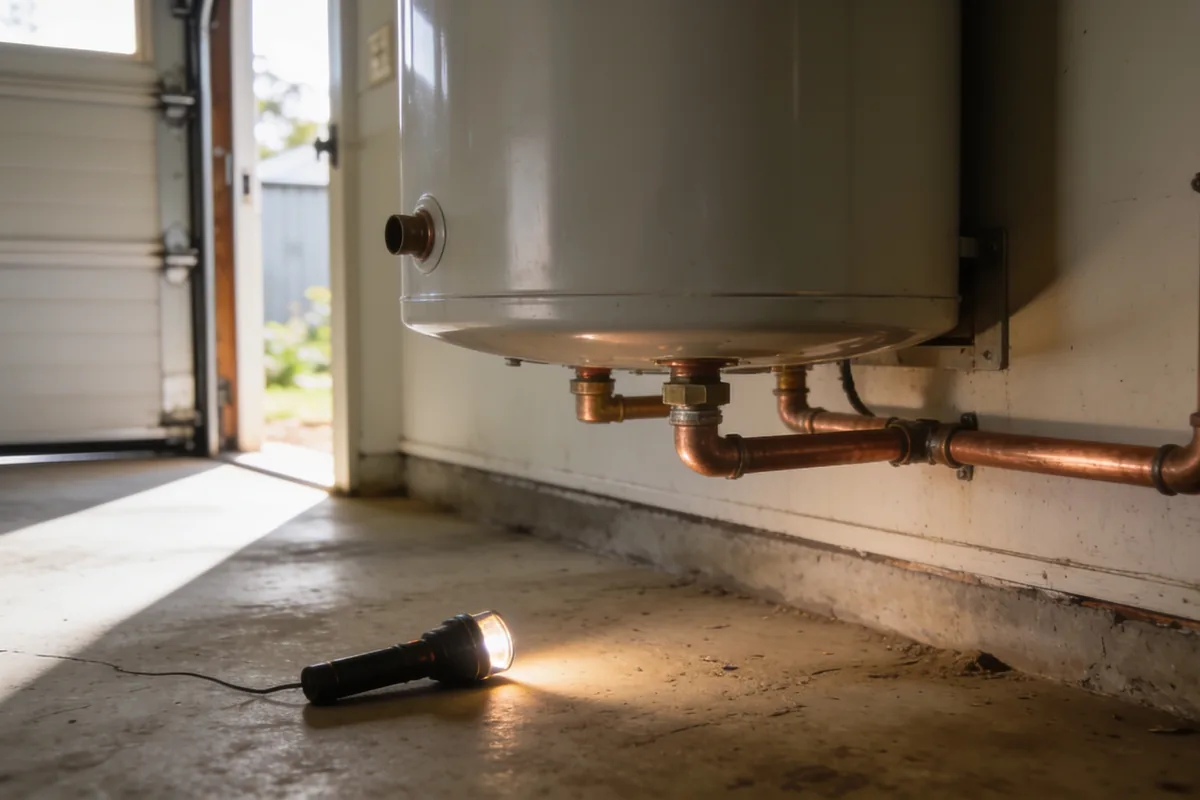
- Look at the base of the tank for any water, using a torch if the spot is dark.
- Write down when the problem started, and whether it happens with every shower or only the second one in a row.
The last note is the useful one. “Every shower” and “only the second one” point towards different causes, and a plumber can often narrow it down from your answer on the phone.
Should I turn the thermostat up?
Not without checking first. In Victoria, the Building and Plumbing Commission says hot water needs to be stored above 60 degrees C to stop bacteria such as Legionella growing. Plumbing law also limits the water at a shower or tap to 50 degrees C, using a tempering valve. So the setting on the tank isn’t a comfort dial. Turning it down or up changes more than how warm your shower feels.
Other states have their own rules, so if you’re outside Victoria, ask your plumber what applies where you live. If you want to spend less on hot water, that’s a separate question with safer answers, and it’s worth asking it before you touch the thermostat.
What if it’s only the second shower?
Then it’s probably capacity, which is just a matter of how much hot water the tank holds against how much the household uses.
The Australian Government’s YourHome guide says one person typically uses about 50 litres of hot water a day. That’s a figure for an average person, so treat it as a starting point and work out what your own household uses.
Take a hypothetical example. Say two people live in a home and use about 50 litres each, which is around 100 litres a day. If the kids come home for the winter holidays and there are now four people, the same tank has to cover about 200 litres a day on that figure. The tank hasn’t got worse. It’s covering twice the use, and the second shower in a row is where you’d notice it first.
If that sounds like your house, a longer gap between showers may be all it needs.
How old is too old?
There isn’t a single age at which a hot water system is finished, so this article doesn’t give one. YourHome notes that a glass-lined storage tank has a sacrificial anode, a part that wears away so the tank doesn’t, and that it needs replacing every few years. A plumber can check it. It’s one of the simplest things to ask about if your system is on the older side.
Before you ring
You’ve got three notes to jot down: when it started, whether it’s every shower or only the second, and what’s at the base of the tank. Add the make of the unit if you can see it, and whether it runs on gas or electricity.
Then ring a licensed plumber. A fast run-out and lukewarm water from the start are both worth a proper look, and the notes will save you a few minutes of questions.
Sources: Building and Plumbing Commission (Victoria), “Hot water safety” (https://www.bpc.vic.gov.au/resource-hub/safety-guides/hot-water-safety); Australian Government YourHome, “Hot water systems” (https://www.yourhome.gov.au/energy/hot-water-service)