Home & Garden
Galvanised Pipes at Home: Is It Lead You Should Worry About, or Rust?

Old galvanised pipes are mostly a rust and pressure problem. The lead worry sits mainly with brass fittings and old solder, according to Australian guidance, so replace pipes when they fail and not because of fear.
Below is how to check your own house, what to do either way, and where the other side has a point.
How to tell what pipes you have
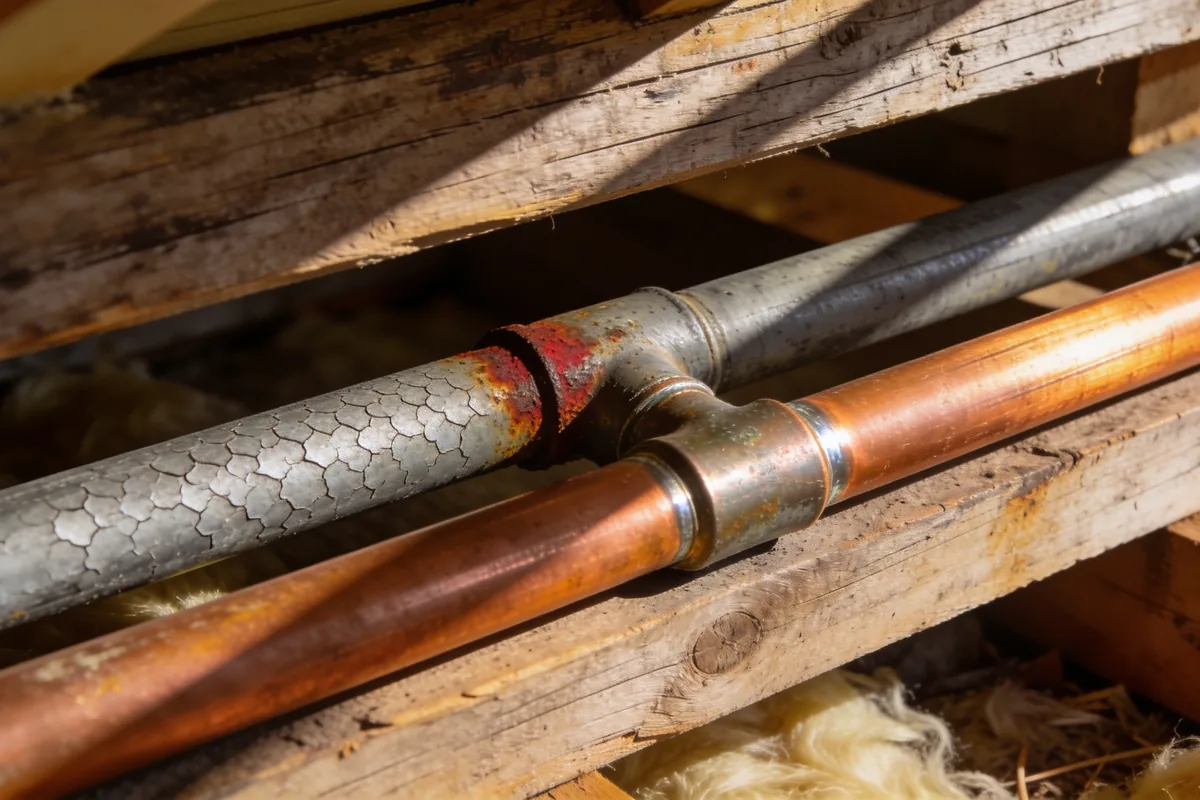
Start with what you can see. Unitywater, a Queensland water utility, says galvanised pipe is grey and usually roughly 25 mm (one inch) across. It also gives a rule of thumb: if the plumbing hasn’t been upgraded in the last 40 years, the pipes are likely galvanised. That’s a Queensland utility’s guide, not a law of nature, so treat it as a prompt to look.
Then match the surface:
- Dull grey, rough, scaly or rusty: most likely galvanised.
- Smooth and orange-brown: most likely copper.
- Black with blue lines: polyethylene.
If you can’t tell, scratch the surface carefully and look at what’s underneath.

The rust test
Galvanised pipes corrode from the inside. Unitywater suggests a simple check:
- First thing in the morning, before anyone uses any water, fill a small white container from the tap.
- Look for discoloured water or particles.
- Repeat once or twice on other mornings.
If it shows up, the inside of the pipe is probably corroded. A licensed plumber can cut out a small section and look inside.
Other signs on the utility’s list are a metallic taste, rust stains on the outside of the pipes, particles in the water, poor pressure and a blocked filter. Its health statement is short: this is generally not harmful.
So is it lead?
Mostly, no. The Australian Government’s enHealth statement on lead in drinking water from plumbing products is the best guide here, and it says a few plain things:
- Town water is regulated, and enHealth describes it as safe.
- It’s unusual to find drinking-water service pipes containing lead in Australia.
- Lead can dissolve from some brass fittings, especially after the water has sat in contact with them for a long time.
- Some older homes have copper pipes joined with lead solder, which licensed plumbers are no longer permitted to use.
- Hot water systems can dissolve more metal than cold water.
- Raised blood lead in Australia is rarely traced to drinking water.
- Infants fed formula made with the water are the higher-risk case.
- There’s generally no need to have water tested for lead.
Notice what isn’t on that list. The enHealth statement doesn’t name galvanised pipe as a source of lead. It names brass fittings and old solder. That doesn’t prove galvanised pipe is harmless in every case. It means the Australian guidance points elsewhere.
What to do either way
enHealth’s steps for householders cost nothing:
- Use the cold tap only for drinking and cooking.
- Flush the cold tap for at least 10 seconds first thing in the morning.
- After more than 48 hours away, flush it for at least 2 minutes.
Unitywater adds that running affected taps for 1 to 2 minutes at the start of the day clears discoloured water. It also says that doesn’t fix the cause.
The other side
Overseas, the position is different. Health Canada’s drinking water guideline document on cadmium says galvanized steel pipes can be a source of both cadmium and lead, especially for systems without corrosion control. That’s a fair point, and it explains why the lead worry travels so easily.
It is Canadian guidance about Canadian systems, though. Australian guidance hasn’t said the same about galvanised pipe. If you have an infant at home or the question still bothers you, ask your water supplier. That’s a reasonable call to make, and it doesn’t commit you to a repipe.
When to repipe
Here’s what Unitywater says: the only way to completely overcome the corrosion problems is to replace the pipe, with polyethylene or copper, by a licensed plumber. It also says the discolouration and taste aren’t a health issue and don’t need to be fixed immediately.
So the trigger is how the house behaves: discoloured water that keeps coming back, pressure that has dropped, or leaks. Those are reasons. Age on its own, or a scary headline, isn’t one.
If you do go ahead, get the job quoted in writing. Ask the plumber to show you the inside of a cut section of your pipe first, so you can see the problem for yourself before you pay to fix it.
Repipe for the right reason
Test the water in a white container. Flush the cold tap. Then decide on pressure and leaks, not on lead.
Sources: Australian Government enHealth, “Lead in drinking water from some plumbing products” (https://www.cdc.gov.au/system/files/2025-10/enhealth-guidance-lead-in-drinking-water-from-some-plumbing-products_0.docx); Unitywater, “Checking galvanised water pipes” (https://unitywater.com/residential/manage-your-water-usage/stop-problems-occurring/galvanised-water-pipes); Health Canada, “Guidelines for Canadian Drinking Water Quality: Guideline Technical Document, Cadmium” (https://www.canada.ca/en/health-canada/services/publications/healthy-living/guidelines-canadian-drinking-water-quality-guideline-technical-document-cadmium.html)