Food
How to Tell if a Mango Is Ripe: Feel and Aroma First, Colour Last

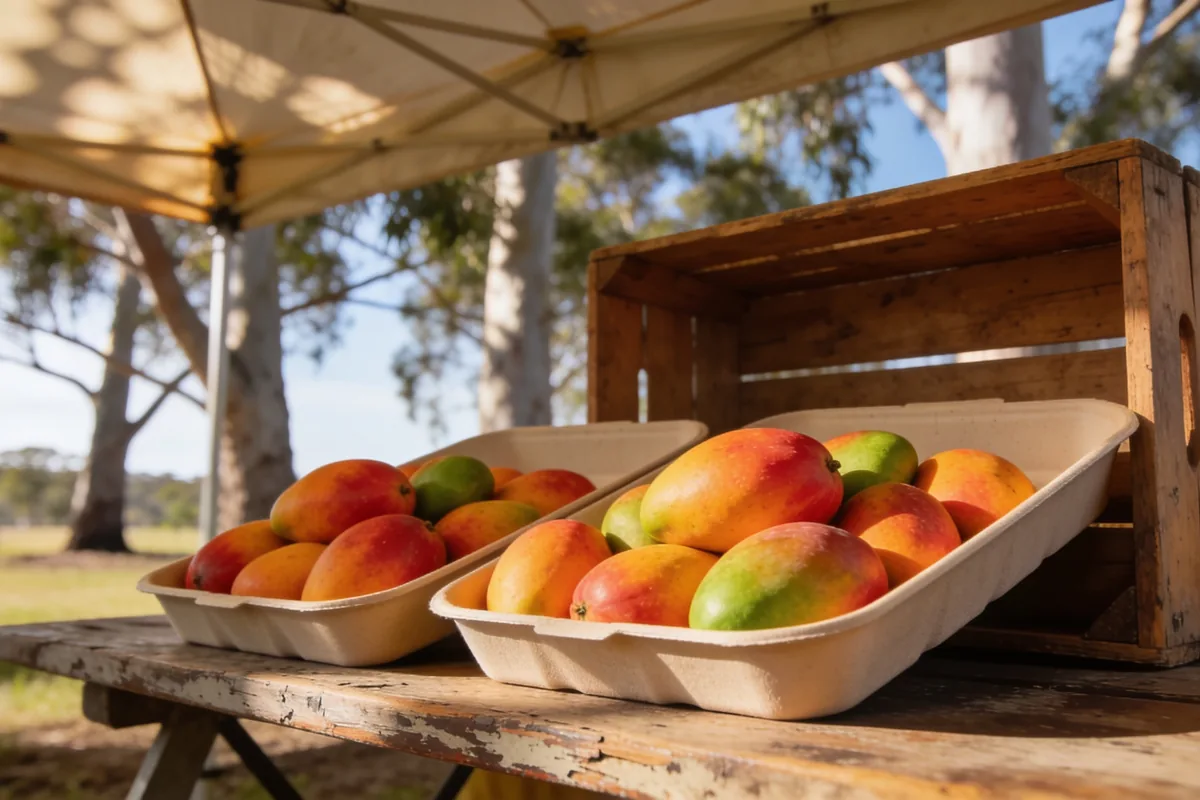
The crates sit in the shade of a canvas awning, and by half past nine the shade is the only cool thing on the table. Two trays of mangoes lean against each other at a tilt, the way trays do when one has been propped on a folded tea towel. The fruit runs through every shade between green and sunset. A few are still green at the shoulder. Most carry a blush of orange, and one or two have gone nearly red.
A hand reaches in and lifts one out. It turns the mango slowly, studying the blush, then rolls it over to check the other side. Beside it, another hand does something different. It holds a mango up under a nose, and the eyes above the nose close, as if the fruit were saying something quietly. The air under the awning smells of sweet resin and warm dust, and the smell comes and goes depending on who has picked up what.
A table leg bows as a full tray is hauled across. A child pokes a mango with one finger, receives a look, and takes the finger back. Further along, a woman puts a mango down, picks up its neighbour, and puts that down too. She tries a third. She holds it for a long moment, slides it into her bag and moves on without looking back.
Behind the crates the gum trees hold perfectly still. The day is going to be hot.
(An invented scene.)
What the industry says to trust
How to tell if a mango is ripe is a question the Australian mango industry answers in its Retail Guide 2025, which is funded by Hort Innovation. The guide opens its advice with a rule: always judge a mango by its feel and its aroma. Colour comes last, and the guide is blunt about it. Don’t rely on colour, it says, because colour is not a reliable sign of ripeness.
On feel, the guide says to use the whole hand and squeeze gently. A ripe mango gives slightly under pressure. Its phrase for the technique is a gentle hug, not a poke. On aroma, ripe mangoes often have a rich and fruity smell. Past that point, an overripe mango feels very soft, shrivelled or wrinkled, and may have a fermented taste and smell. So the guide describes a narrow window: firm enough to hold its shape, soft enough to give a little, fragrant, and not yet collapsing.
Mangoes Australia says much the same in plainer words. The skin gives a little when it is pressed softly. A mango that feels too mushy is over-ripe. A ripe one has a sweet fragrance. It also makes an allowance for colour that the guide does not spell out in the same place: the skin turns from green to orange, red or rosy depending on the variety, and different varieties develop different skin tones. Small blemishes from rubbing on the tree do not affect the flesh.
At a market table a blemish can look like a reason to walk away. The site says it is not one.
The two sources agree on the order of trust. Feel is first, aroma second, and colour is a supporting detail at best. The next section shows where colour does carry some information, because the guide’s own variety notes mention it.
Variety by variety
The guide says Australian production through the peak is dominated by Kensington Pride, Calypso, R2E2 and Honey Gold, with one late-season variety, Keitt. It gives each a set of months and a ripeness indicator. The table keeps its wording as closely as a table allows.
| Variety | Available | Ripeness indicator (the guide) | Skin as described |
|---|---|---|---|
| Kensington Pride | Sept to Feb | Strong aroma and gives slightly to gentle pressure | Yellow to orange tinged with a pink blush |
| Calypso | Sept to Mar | No green and gives slightly to gentle pressure | Deep pink blush |
| R2E2 | Oct to Feb | Gives slightly to gentle pressure | Orange with a red blush, large and round |
| Honey Gold | Nov to Mar | Golden skin, strong aroma and gives slightly to gentle pressure | Golden apricot |
| Keitt | Jan to Mar | Gives slightly to gentle pressure | Pinky red blush |
The months stagger through the season. Kensington Pride and Calypso start in September, R2E2 follows in October, Honey Gold arrives in November, and Keitt closes the season from January to March. Four of the five are therefore listed as available in November, and only Keitt is not. That makes this a good month to read the table against real fruit.
Read down the indicator column and one phrase repeats: gives slightly to gentle pressure. It appears for every variety. Aroma is named for Kensington Pride and Honey Gold. Colour appears twice inside the indicator itself. Calypso’s cue includes “no green”, and Honey Gold’s includes golden skin. So colour is not absent from the guide’s own advice. It is a supporting cue for some varieties, and it is never the first one.
Mangoes Australia’s page on Kensington Pride lines up with the guide. It gives peak availability as September to February, a strong mango aroma, and a skin that is slightly soft to the touch, yellow to orange and tinged with a pink blush.
The guide also draws a line between two kinds of mango, and it matters more than any single row in the table. For soft-eating mangoes such as Kensington Pride, softness is the best indicator and skin colour is less reliable. For the firm-eating mangoes, Calypso and R2E2, firmness is harder to judge, so the guide points to a sweet aroma and slight softness near the stem. A shopper who learns only one habit, squeezing, will do well with the first group and less well with the second. The second group asks for the nose.
Green but soft, hard but coloured: what the cues do when they disagree
A mango can be green but soft. Another can look beautifully coloured and feel like a stone. The guide has an answer for each, and the answer comes from the order of trust.
For the green but soft one, colour is not a reliable sign of ripeness, so green skin alone does not rule the fruit out. In a soft-eating variety, softness is the best indicator. A mango that gives slightly under a gentle squeeze and smells sweet has passed the two tests the guide cares about most, whatever the shoulder looks like. The guide does not claim that any variety stays green when ripe, and neither does this article. It says only that colour should not decide the question on its own.
For the coloured but hard one, the cues have fallen out of step. A blush has arrived but the give has not. The guide’s advice is to wait: mangoes ripen at room temperature over a few days, so a hard mango can be left on the bench. This is also the case where the Calypso cue earns its keep. The guide’s indicator for that variety is “no green” together with a slight give, so a Calypso with a green patch has not met its own cue yet, however pink the rest looks.
When the cues disagree, the sources point the same way each time. Trust the hand and the nose, and treat colour as a tiebreaker.
Mangoes Australia adds a buying tip that sits comfortably with all of this. For fruit that has to be held a few days, choose a slightly firmer mango with tight skin. A shopper buying for the weekend and a shopper buying for tonight are therefore looking for different things, and the same crate can serve both.
Ripen on the bench, then the fridge
On a kitchen bench by a window, three mangoes sit in a row, and no two are alike. The left one is hard as a cricket ball and green to the stem. The middle one carries a faint blush and has begun to smell of something sweet. The right one is gold and slightly yielding, and the whole room smells of it. A brown paper bag lies open beside them, creased from a morning of use. Tonight someone will cut into the one on the right. The left one can wait.
(Another invented scene.)
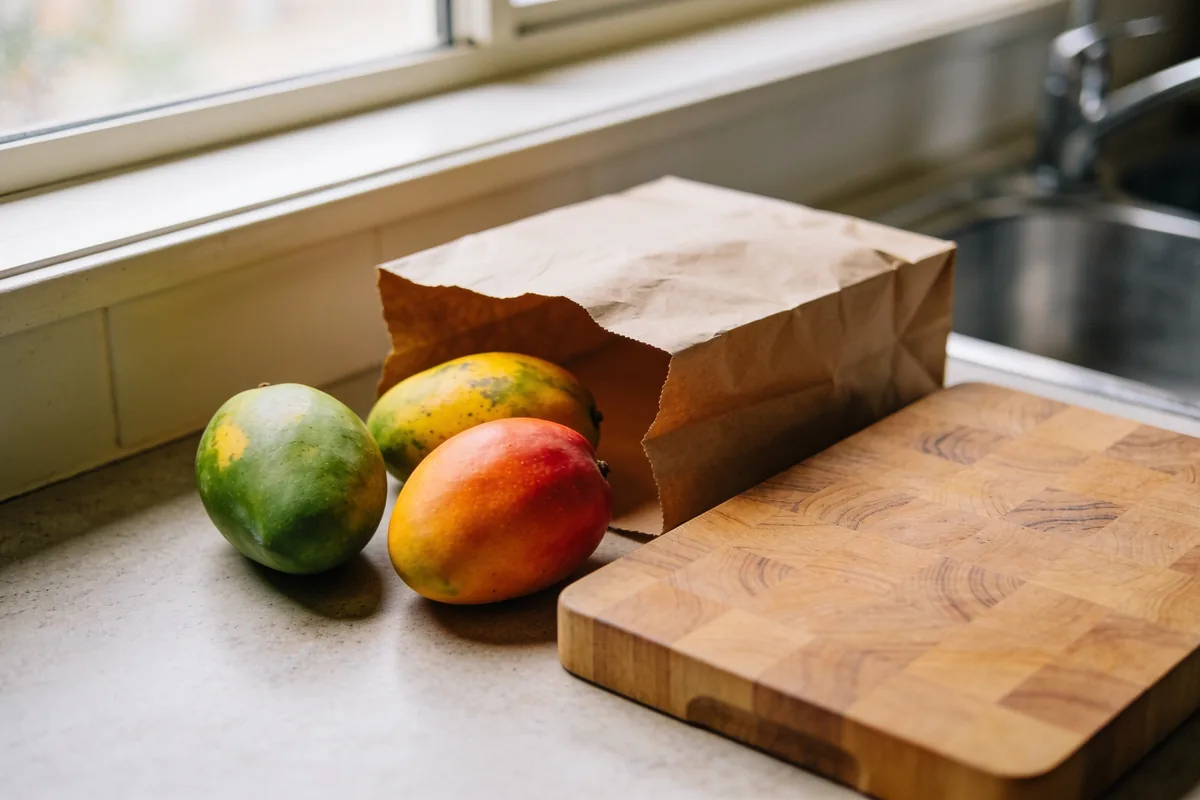
The guide and Mangoes Australia give the storage rules as numbers and plain instructions. Mangoes that are not yet ripe should sit at room temperature, between 18 and 22 degrees Celsius, out of the sun, for a few days until the fruit ripens. A paper bag for a few days helps. Mangoes should never be stored in plastic bags, because mangoes need air.
The refrigerator comes later. Both sources say a mango should not be refrigerated until it is ripe, and a mango will not ripen in the refrigerator. Once a mango is fully ripe, it can go in the fridge for a few days, and its shelf life is about a week. That is a short window, and it explains why the buying advice leans on timing.
Mangoes Australia also lists what to do with fruit that is ripe and more than a household can finish. Ripe mangoes can be frozen, dried, cooked in syrup or puréed.
One more figure sits in the guide, aimed at the trade. In handling and transport, mangoes are meant to be kept above 12 degrees Celsius, because cold temperatures can cause chill damage. That is a supply-chain instruction and not a household one, but it fits with the home rule. The cold is for fruit that has finished ripening, not for fruit that has barely started.
Put together, the sequence is short. Buy by feel and aroma. Give the unripe ones a few days at 18 to 22 degrees, out of the sun and with air around them. Once a mango is ripe, the fridge keeps it for a few days, and the shelf life is about a week.
Hold It, Do Not Poke It
Back under the awning, the trays have been picked over and the gap in the crate has closed up where someone has shifted the fruit. The mangoes left are the ones with green at the shoulder. That is not a verdict on them. It is a prompt to hold one, give it a gentle hug and breathe in.
Hand first, nose second, colour last.
The rest is a few days on the bench for whatever is not ready, and the fridge for whatever is.
Sources: Australian Mango industry, Retail Guide 2025, funded by Hort Innovation (https://www.industry.mangoes.net.au/cmsb/uploads/australian-mango-retail-guide-2025-v2.pdf); Mangoes Australia, When are mangoes ready to eat? (https://mangoes.net.au/mango-tips/when-are-mangoes-ready-to-eat/); Mangoes Australia, How to store a mango (https://www.mangoes.net.au/mango-tips/how-to-store-a-mango/); Mangoes Australia, Kensington Pride (https://www.mangoes.net.au/varieties/kensington-pride-mango-aka-the-bowen/)


How to Tell if a Mango Is Ripe: Feel and Aroma First, Colour Last

NDIS Worker Orientation Module: What to Do While the Online Course Is Offline

Exercise Prescription: How the FITT Principle Builds a Personal Plan
NDIS Worker Orientation Module: What to Do While the Online Course Is Offline

Gutter Overflowing in the Rain? Where to Look First

Engine Coolant Myths: What Water, the Gauge and the Calendar Get Wrong
-
 Healthcare3 days ago
NDIS Worker Orientation Module: What to Do While the Online Course Is Offline
-
 Home & Garden12 months ago
Gutter Overflowing in the Rain? Where to Look First
-
 Automotive12 months ago
Engine Coolant Myths: What Water, the Gauge and the Calendar Get Wrong
-

 Healthcare9 months ago
Stiff Joints in the Morning: What Is Normal and When to See a GP
-

 Home & Garden11 months ago
Galvanised Pipes at Home: Is It Lead You Should Worry About, or Rust?
-
 Healthcare5 days ago
Exercise Prescription: How the FITT Principle Builds a Personal Plan
-

 Home & Garden11 months ago
Cut Your Hot Water Bill: Four Fixes and One to Skip
-

 Family & Parenting12 months ago
Respite Options for Carers of Children with Special Needs