Pets & Animals
How to Stop a Dog Barking: Start With What the Bark Is Saying

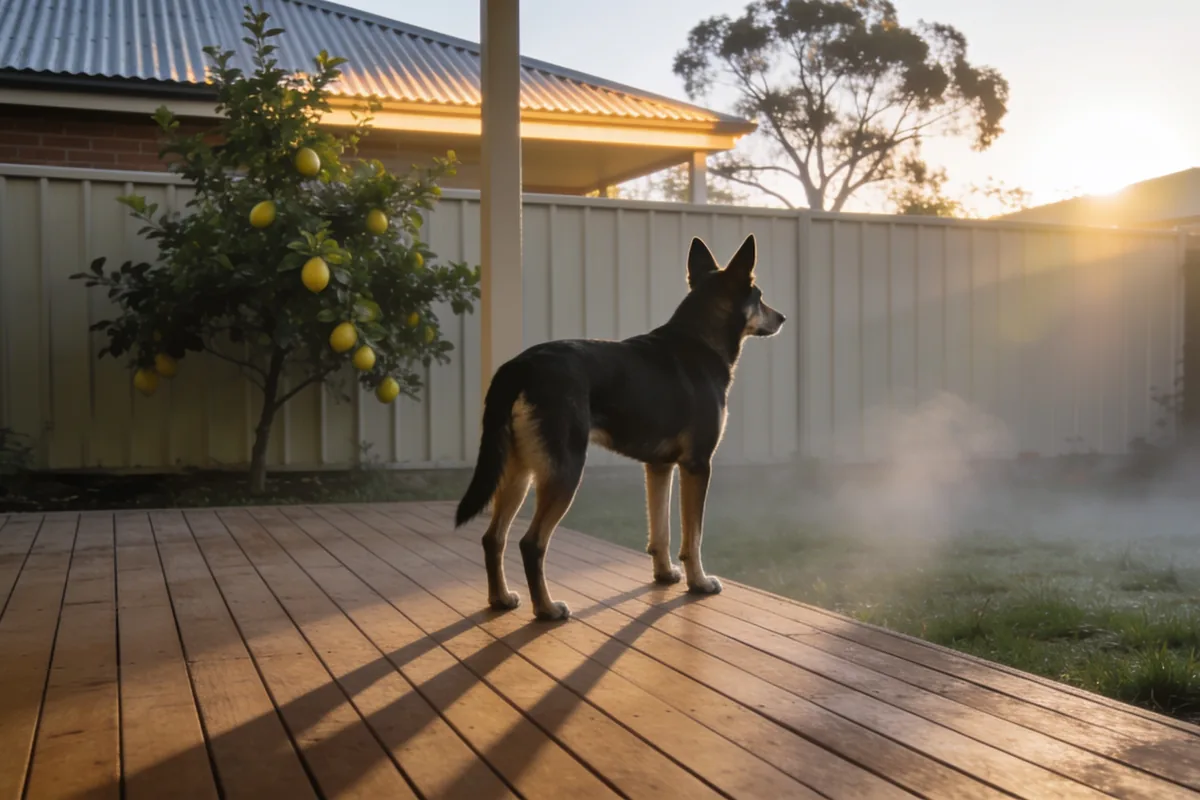
The street is the colour of weak tea. Nothing has moved yet except the mist on the lawns, which lies in low, flat sheets and has not decided whether to lift. A gate latch clicks somewhere down the row, one thin metallic note, and then the quiet closes over it again.
On a back deck behind a paling fence, a mid-sized dog gets to her feet. She was lying with her chin on the boards. Now her ears are up and her weight is forward, and she is looking at a corner of the fence where, as far as anyone watching could tell, there is nothing at all. The lemon tree drips. A corrugated roof ticks as the first light finds it, and a wet towel hung over the rail sags a little further toward the boards. The air smells of cut grass from yesterday and cold earth from the beds along the fence.
She barks. It is a short, flat bark, then another, then a run of them, each landing a little harder than the last, and the sound goes out over the fences and the clotheslines and the wet bitumen. A magpie leaves a gum in a hurry.
Inside the house behind her, the back door is shut, a lead hangs on its hook and the kettle is cold. Two doors down, a bedroom window goes from grey to yellow. A hand pulls a curtain back an inch and lets it fall. The dog barks on, steady now, facing the corner of the fence, and the street waits to see which of them will give in first.
(An invented scene.)
What the bark is saying
Anyone searching for how to stop a dog barking will find the first answer is not a technique. It is a question: why is this dog barking at all? A bark is not one message, and the RSPCA lists several quite different reasons.
Boredom, loneliness and frustration come first. A dog left with nothing to do and no one to do it with will find some way to fill the hours. Fear is another reason. So is territorial behaviour, which the RSPCA describes as natural, since it is “natural for a dog to want to warn others about real or perceived threats”. Separation anxiety is a fourth, and the RSPCA says it “requires veterinary treatment”.
Agriculture Victoria adds to the list. Dogs bark to seek attention, and some bark because of a medical condition or an unmet physical need. Its advice is to rule out medical reasons first. The NSW Environment Protection Authority (EPA) names the conditions in which a dog is more likely to bark: chained or cramped, given little exercise, sick, hungry or thirsty.
The tool all of these sources point to is a diary. The RSPCA suggests keeping a record of when and where the barking happens, what seems to set it off, whether the household is home or away, and how much exercise the dog has had. A diary turns a noise into a pattern, and a pattern is far easier to act on than a noise. It is also, as a later section shows, the first thing a council asks for when a neighbour complains.
What to do while you work out why
While the cause is being found, the sources describe what helps, and most of it is plain. Agriculture Victoria recommends walks once or twice a day, along with toys and puzzles to keep the dog occupied. Where passers-by set the dog off, it suggests blocking the view with solid fencing, shade cloth or hedging. Where fear or separation anxiety is behind the barking, it points to counterconditioning, done with a vet, a behaviourist or a trainer. And it says never to hit the dog.
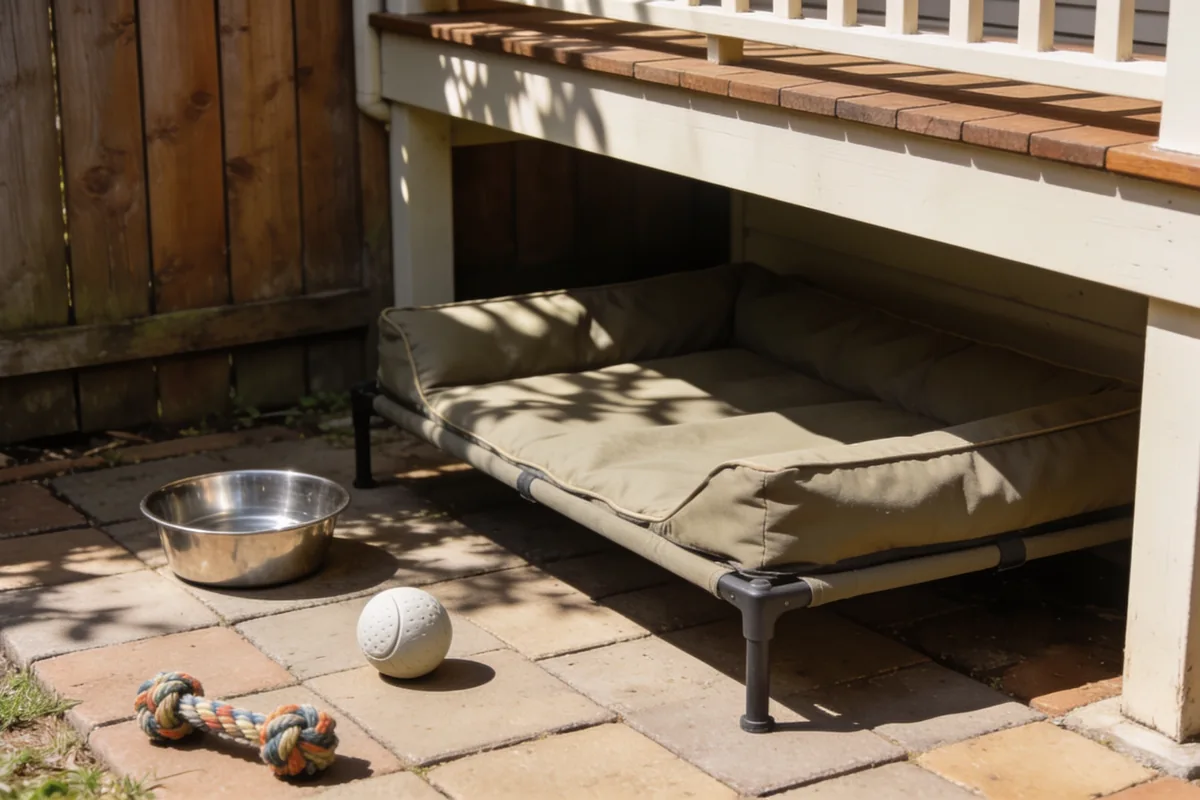
The NSW EPA adds two points about the physical set-up. Shelter is a legal requirement in NSW, under section 8 of the Prevention of Cruelty to Animals Act 1979, and noise insulation around a kennel can reduce how far the sound carries. On separation anxiety there is one line to add and no more. The RSPCA says it needs veterinary treatment, so a dog that barks mostly when left alone is a question for a vet before it is a question for any training method.
Take a hypothetical household whose dog barks every morning at the footpath. The diary shows that it begins when the first walkers pass the fence. Agriculture Victoria’s options fit that pattern: block the view of the footpath with solid fencing, shade cloth or hedging, and make sure the dog has had a walk and has something to occupy it. The work is finding the trigger and either taking it away or answering it.
Why the collar is the wrong shortcut
The shortcut most often offered is a device. The RSPCA’s position, set out in its knowledge base and updated in December 2025, is that using punishment, “such as yelling, spraying water, or anti-bark collars”, may stop barking temporarily but often makes the problem worse. On the RSPCA’s reasoning, a punishment adds fear to a dog that may already be barking from fear. The RSPCA also opposes any electronically activated device that delivers electric shocks or other aversive stimuli.
The law on electric collars varies, and the RSPCA publishes a table. On the RSPCA’s table, current to December 2022, electric collars are prohibited in the ACT, New South Wales and South Australia, while Victoria permits authorised electric collars subject to conditions and exemptions, under its Prevention of Cruelty to Animals Regulations 2019. Across the eight jurisdictions, then, there is not one rule. The same table lists Queensland as having no current prohibition, and the Northern Territory, Tasmania and Western Australia as not prohibiting electric training collars outright (Tasmania restricts them in sport and public performance, and Western Australia’s Animal Welfare Act is under review). The RSPCA states that the table is not intended to be relied on for legal advice. It is also more than three years old at the time of writing, so anyone weighing a device should check the current Act for their own state or territory before buying one.
A collar silences the sound and leaves the reason exactly where it was. That is the practical objection, as well as the kind one.
If a neighbour’s dog is the problem
For the neighbour, the sources agree on the order of events. Talk first. The RSPCA, Agriculture Victoria and the NSW EPA all say to start with a conversation. Free mediation exists if that does not work: New South Wales has Community Justice Centres, and Victoria has the Dispute Settlement Centre. Then, if the barking continues, keep a dated diary and take it to council. The RSPCA notes that councils are responsible for following up complaints about nuisance barking.
After that, the process depends on the state, and on the council. The table sets out four examples, each taken from that jurisdiction’s own page.
| Jurisdiction | Who acts and under what | Steps and evidence | What can follow |
|---|---|---|---|
| New South Wales (NSW EPA fact sheet, May 2021) | Council, under the Companion Animals Act 1998 | Council may ask for a diary and statements; a notice of intent says how the behaviour must change and gives the owner a right to object | A nuisance order, in force for six months, which the owner cannot appeal; fines for breach. Or the complainant may ask the local court for a noise abatement order under section 268 of the Protection of the Environment Operations Act 1997 (fees apply; the owner can appeal) |
| Victoria (Agriculture Victoria) | Council; the law is not named on the page read | Council may ask for a diary “for a few weeks” and support from another affected neighbour | A warning or Notice to Comply; an infringement notice; legal action and a Court Order |
| Western Australia (Department of Local Government, Industry Regulation and Safety guideline, first published 21 November 2025, updated 18 June 2026) | An authorised person, under section 38 of the Dog Act 1976 | Evidence includes personal observation, corroborating statements (possibly through a Form 7) and a bark-count collar | An order in effect for six months; a fine of $5,000 for a breach by a non-dangerous dog; a modified penalty of $200 |
| Queensland, City of Moreton Bay only (council page) | Council, under its Animal Management Local Law 2023; the test is repetitious or incessant barking that unreasonably disrupts | A 7-day diary with dates, times and triggers; a noise-recording device at the complainant’s property for 7 days; anonymous complaints are not accepted | Not covered by the sources read |
Read across the four rows and one request repeats in different words: show the pattern. New South Wales asks for a diary and statements. Victoria asks for a diary kept for a few weeks and support from another affected neighbour. Western Australia lists personal observation, corroborating statements and a bark-count collar. The City of Moreton Bay asks for a seven-day diary and, separately, a recording device left at the complainant’s property for seven days. In every case the authority wants something it can put in front of an owner, and a vague complaint gives it nothing to put.
New South Wales also offers a second route that the other three pages do not describe. A complainant may instead ask the local court for a noise abatement order under section 268 of the Protection of the Environment Operations Act 1997. Fees apply, and unlike the council’s nuisance order, the owner can appeal it.
Two cautions apply to the table. The Queensland row is one council’s rule, the City of Moreton Bay’s, and not the state’s. And diary lengths vary: that council asks for seven days, while Victoria’s page says “a few weeks”. A complainant should read their own council’s page before starting.
What a council might count
The Western Australian guideline goes further than most, because it lists benchmarks. The listed figures are more than six minutes of barking in any hour between 6am and 10pm, more than three minutes in any 30 minutes between 10pm and 6am, and 240 or more barks between 6am and 10pm and 32 overnight.
The same document is careful about what those numbers are. It says “there is no set standard”, and that the benchmarks are “not necessarily tried and tested at court”. A council’s own policy may differ. A little arithmetic helps to size them: six minutes in an hour is a tenth of that hour, and the overnight figure of three minutes in any 30 is the same proportion over a shorter window. The numbers are best read as the kind of thing an authorised person might look at, and not as a line that decides whether barking is a nuisance.
If you are the owner and a letter arrives
A letter from a council is worth answering early. In NSW, an owner who receives a notice of intent has a right to object before any order is issued, and cannot appeal the order once it is made, so the objection is the owner’s chance to be heard. The diary works on the owner’s side too. It shows when the dog barks and what sets it off, which is what the RSPCA suggests recording, and a record that shows a pattern is a better place to start a conversation than a guess. If the owner has changed something since the barking began, such as an extra walk, a screen across the fence or shade cloth over the view, the diary is also where that change and its effect are written down. Agriculture Victoria lists each of those as a sensible step, and a council reading the owner’s reply can see that the owner has acted on them.
Listen First
Back on the deck, the light has reached the boards and the dog has stopped. She stands a moment longer with her nose toward the corner of the fence, then turns twice and lies down with her chin on her paws. Down the street the curtain two doors along has not moved. Somewhere a kettle is being filled.
Whoever is at the window, and whoever is on the deck, the next step is the same. Write down what happens and when.
A bark is information before it is noise.
Sources: RSPCA Knowledgebase, What causes dogs to bark excessively? (https://kb.rspca.org.au/knowledge-base/what-causes-dogs-to-bark-excessively/); RSPCA Knowledgebase, My neighbour’s dog is constantly barking and disturbing me, what should I do? (https://kb.rspca.org.au/categories/companion-animals/dogs/behaviour/my-neighbours-dog-is-constantly-barking-and-disturbing-me-what-should-i-do); RSPCA Knowledgebase, Is the use of electronic dog collars legal? (https://kb.rspca.org.au/knowledge-base/is-the-use-of-electronic-dog-collars-legal/); Agriculture Victoria, Barking dogs (https://agriculture.vic.gov.au/livestock-and-animals/animal-welfare-victoria/dogs/dog-training-and-behavioural-problems/barking-dogs); NSW Environment Protection Authority, Dealing with barking dogs, May 2021 (https://www.epa.nsw.gov.au/sites/default/files/21p3038-dealing-with-barking-dogs.pdf); Department of Local Government, Industry Regulation and Safety (WA), Best Practice Guideline on the Identification, Investigation and Handling of Nuisance Dogs, updated June 2026 (https://www.dlgsc.wa.gov.au/department/publications/publication/best-practice-guideline-on-the-identification-investigation-and-handling-of-nuisance-dogs); City of Moreton Bay, Barking dogs (https://www.moretonbay.qld.gov.au/Services/Animals/Dog-Ownership-And-Complaints/Barking-Dogs)


NDIS Worker Orientation Module: What to Do While the Online Course Is Offline

Exercise Prescription: How the FITT Principle Builds a Personal Plan

The Spam Act: An Unsubscribe Link Cannot Fix a Message Sent Without Consent
NDIS Worker Orientation Module: What to Do While the Online Course Is Offline

Gutter Overflowing in the Rain? Where to Look First

Engine Coolant Myths: What Water, the Gauge and the Calendar Get Wrong
-
 Healthcare2 days ago
NDIS Worker Orientation Module: What to Do While the Online Course Is Offline
-
 Home & Garden12 months ago
Gutter Overflowing in the Rain? Where to Look First
-
 Automotive12 months ago
Engine Coolant Myths: What Water, the Gauge and the Calendar Get Wrong
-

 Healthcare9 months ago
Stiff Joints in the Morning: What Is Normal and When to See a GP
-

 Home & Garden11 months ago
Galvanised Pipes at Home: Is It Lead You Should Worry About, or Rust?
-
 Healthcare3 days ago
Exercise Prescription: How the FITT Principle Builds a Personal Plan
-

 Home & Garden10 months ago
Cut Your Hot Water Bill: Four Fixes and One to Skip
-

 Family & Parenting12 months ago
Respite Options for Carers of Children with Special Needs