Business
Business Name Registration in Australia Gives You Permission, Not Ownership


Register the name, because you have to. Then don’t mistake the registration for ownership, because it isn’t.
Search for business name registration Australia and most of what comes back explains how to sign up and pay. Very little of it tells you what you’ve bought once you have. The answer is permission to trade under a name, plus protection against one narrow thing: an identical or nearly identical business name. It isn’t exclusive rights, and it isn’t brand protection. This article sets out what the register covers in the government’s own words, where that cover stops, a ten-minute check to run before you print anything, and the fee that applies from 1 July 2026. It is general information, not legal advice, and it draws only on business.gov.au, ASIC and IP Australia. The register is a licence to trade, not a title deed.
What registration does, in the government’s own words
The word “registered” does a lot of damage here, because both registers use it. A registered business name means ASIC has recorded the name and you may trade under it. A registered trade mark means IP Australia has recorded exclusive rights to it. The two words look identical on a form and mean very different things.
Start with what you get, because it isn’t nothing. business.gov.au says it’s an offence to trade under an unregistered business name unless it’s the same as your own name. It adds that once you’re registered, you can use your business name Australia wide. ASIC says registering a business name protects you from another business using an identical or nearly identical name. That is a real benefit. It is also the whole of it.
Now the limits, which the same bodies state just as plainly. business.gov.au says: “Registering a business name doesn’t mean you have exclusive rights to use it.” ASIC says registration does not stop another business using a name with similar words, and does not protect you against legal action if you use someone else’s trade mark. ASIC’s Information Sheet 187, issued in July 2019, goes a step further. It says there is no exclusive right to the name “or any part of the name”, no protection of a name or a brand “like a trademark”, and that a trade mark holder can still act.
Put those lines together and the shape is plain. The register stops a copy of your name. It doesn’t stop a lookalike, and it doesn’t stop a trade mark owner. Three government bodies describe it the same way, so there’s very little room to argue. What a trade mark adds, on business.gov.au’s account, is exclusive trading, branding or ownership rights over your business name, and a business name entry cannot do that job however carefully you fill in the form.
A name on one register, rights on another
Two registers do two different jobs. ASIC runs the business names register. IP Australia runs the trade marks register. The table sets out what each gives, what it doesn’t, and who says so.
| Register | What it gives | What it does not give | Source |
|---|---|---|---|
| Business name (ASIC) | Permission to trade under the name, Australia wide; protection from an identical or nearly identical business name | Exclusive rights to the name or any part of it; protection “like a trademark”; a bar on a trade mark holder acting | business.gov.au; ASIC; ASIC Information Sheet 187 |
| Trade mark (IP Australia) | Exclusive rights to use your trade mark in Australia; lasts up to 10 years, renewable indefinitely | Not covered by the sources read | IP Australia |
| Domain name | Not covered by the sources read | Protection for your business name | IP Australia |
There’s a catch that makes this easy to misread. business.gov.au says you can’t register a business name that someone else has registered as a business name or trade mark. That sounds like a safety net, and it’s worth having. But ASIC says its own review process, the one that looks at a registration decision, only asks whether ASIC followed the Business Names Registration Act 2011. Trade marks, passing off and competition matters sit outside that review. So the register’s checks are not a ruling on who owns a brand.
A domain name is a third thing again. IP Australia says a domain name doesn’t protect your business name. A business that holds the registered name and the matching web address has two useful things and still hasn’t got exclusive rights. The rights that do come with a trade mark are set out in section 20 of the Trade Marks Act 1995 (Cth), the section on rights given by registration of a trade mark.
The ten-minute test before you print anything
Here’s the test. Do it before you pay for signs, packaging, uniforms or a website, because that’s when a wrong answer costs the least.
Question one: is the name already a trade mark? business.gov.au points to IP Australia’s TM Checker for this. Search your exact name, then the obvious variations. ASIC is clear that a registered business name does not protect you against legal action if you use someone else’s trade mark, so this is the question with the sharpest edge.
Question two: is a similar name already out there? ASIC says the register doesn’t stop similar words appearing in another business’s name, so a clear register proves less than it feels like. Search the business names register, then search the way a customer would, and look at what turns up beside it.
Question three: would losing the name hurt? Picture the name on your products, your signage and your website. If changing it later would cost you customers or money, a trade mark is the thing that carries exclusive rights, and ASIC recommends legal advice when a name dispute arises. ASIC also says that to protect your business or company name, you can consider registering a trade mark yourself. Keep a note of the date and what you searched for. A dated record of a clean search is cheap to make and awkward to reconstruct later.
Take a hypothetical case. Say a one-person furniture maker plans to put a new trading name on stools, a van and a website. Questions one and two come back clean, and question three comes back with a firm yes. The register entry is still worth having, because trading under an unregistered name is an offence unless it’s your own name. But the maker should treat it as step one, and ask about a trade mark before the name is on anything permanent.
What would change the verdict? A yes to question one means stop and take advice before going further. A no to all three, and you can reasonably stay at the register for now.
What ASIC can and cannot do in a dispute
Many owners assume that if someone copies a registered name, ASIC will sort it out. ASIC’s Information Sheet 187, Disputes about similar business names, says something more careful. ASIC says it “may not always be able to help”. Its review looks only at whether it followed the Business Names Registration Act 2011 when it made its decision. It doesn’t take in passing off, competition law or trade marks.
Those matters go elsewhere. The sheet points to the Australian Competition and Consumer Commission (ACCC) for passing off and misleading conduct, and to IP Australia for trade marks. For legal advice, it points to the Law Society of your state or territory.
That routing gives a practical order. If the worry is that customers are being misled by a lookalike, the sheet points to the ACCC. If the worry is a trade mark, it points to IP Australia. If the worry is where you stand, it points to a lawyer. In practice that means a business name registration is a record of permission to trade, not a remedy against a lookalike. If a dispute does arise, ASIC says to get legal advice, and a lawyer is the right person to tell you where you stand. This article can’t.
What it costs, and the date that matters
The cost question gets a straight answer here. From 1 July 2026 the fee is $47 for one year and $108 for three years. Before that date it was $45 and $104. business.gov.au, in a news item published on 9 June 2026, says the change is in line with the March-quarter Consumer Price Index (CPI).
Fees move with the CPI, so check the current figure on business.gov.au when you register or renew, rather than trusting any number in an article, this one included. Diarise the renewal date as well. It comes round every year or every three years, depending on which term you chose.
No trade mark fee appears here. IP Australia sets it, and IP Australia’s own site is the place to read it.
The fair case for stopping at the register
There is a fair case for stopping at the register, and it deserves a straight hearing. For a small local trader, the register entry plus honest use of the name may be enough in practice. A trade mark is a commitment as well as a protection. IP Australia says registration lasts up to 10 years and can be renewed indefinitely, which means you’re signing up to look after it, and it has costs of its own that IP Australia publishes.
A business that never trades beyond one suburb, never puts the name on goods and never sells online might reasonably decide not to carry that. Registering the name still blocks an identical or nearly identical business name, and that is not nothing.
Say a one-person mowing service works two suburbs, uses the owner’s van and puts a business name on its invoices. Bookings come by phone. That business has little riding on the name beyond its local reputation, and the register entry does the job it was built for. Now say the same business starts selling branded gear online. The name is on goods, it travels, and the answer to question three is no longer the same.
Here’s what would change the verdict. Selling beyond your local area changes it. Selling online changes it. Putting the name on goods changes it. Any of those raises the cost of losing the name, and at that point the question stops being whether a trade mark is a commitment and becomes whether you can afford to be without exclusive rights.
Register, Check, Then Decide
Register the name because the law expects it, check the trade mark register and the business names register before you spend money on anything with the name on it, and then decide whether the exclusive rights that only a trade mark carries are worth the commitment for the way you trade, so that the registration does the job it was built for and nobody expects more from it. This is general information only. A dispute over a name is a matter for a lawyer.
Sources: business.gov.au, Register a business name (https://business.gov.au/registrations/register-a-business-name); business.gov.au, Business names, trading names and legal names (https://business.gov.au/planning/new-businesses/business-names-trading-names-and-legal-names); business.gov.au, Changes for businesses from 1 July 2026, published 9 June 2026 (https://business.gov.au/news/changes-for-businesses-from-1-july-2026); ASIC, Register a business name (https://www.asic.gov.au/for-business-and-companies/business-names/register-a-business-name); ASIC, Disputes about similar business names, Information Sheet 187, July 2019 (https://asic.gov.au/about-asic/contact-us/how-to-complain/disputes-about-similar-business-names/); IP Australia, Understanding trade marks (https://www.ipaustralia.gov.au/trade-marks/understanding-trade-marks)




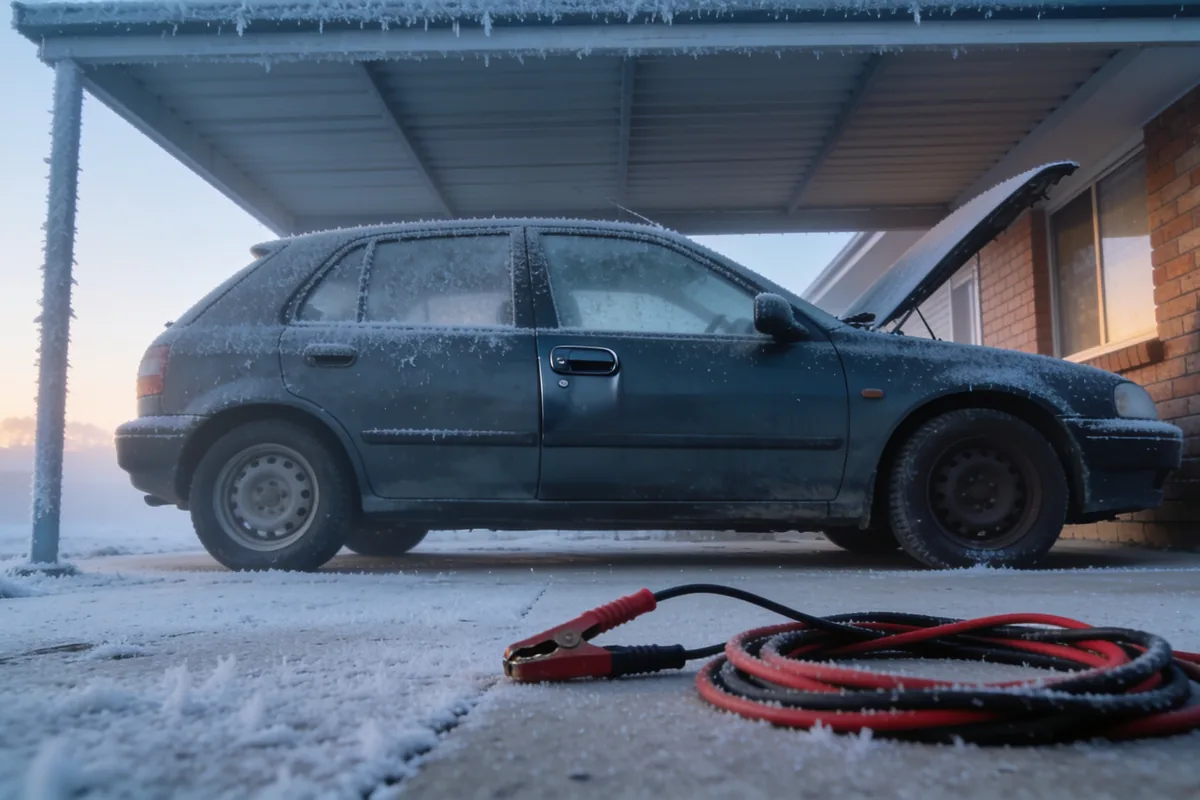
The standard method for jump starting a car is sound for one situation only: a flat battery, a 12-volt system, a second car with a healthy battery, and an owner’s manual that says nothing different. Outside that situation the method stops applying in at least five identifiable ways, and on one step, whether the engine of the donor car should be running, two Australian motoring clubs publish opposite instructions. The finding is therefore short. The handbook for the car in the driveway governs, a roadside service is the fallback when the handbook is unclear, and the generic sequence found on most websites is a floor, not a ceiling.
That finding rests on three documents: a guide from RACV published in March 2026, a jump-start FAQ from RAC in Western Australia, and the jump-starting section of a 2023 Kia owner’s manual for a hybrid model. This article is general information about how to jump start a car, not advice for a particular vehicle. The owner’s manual and a roadside assistance provider are the authorities for any given car, and nothing below replaces them.
Two limits apply. Three documents are a narrow base, and the manual covers one manufacturer’s hybrid, so every row in the table later in this article names its source instead of claiming a rule for all cars. The article also prints only the figures those documents print. It does not rate batteries, price replacements or compare equipment, because none of the three does.
The standard method, and who agrees on it
RACV’s guide, published in March 2026, sets out the sequence most drivers have seen in some form. Written as steps, it reads as follows.
- Switch both cars off, park them or leave them in neutral, and put the handbrakes on.
- Attach one red clamp to the positive terminal of the flat battery.
- Attach the other red clamp to the positive terminal of the charged battery.
- Attach one black clamp to the negative terminal of the charged battery.
- Attach the other black clamp to “a piece of bare, unpainted metal on the car with the flat battery (such as a nut on the engine block)”. RACV adds that this clamp must not go on the flat battery’s terminal.
- Start the charged car and let it run for one minute.
- Start the car with the flat battery, and leave both cars running for several minutes.
- Disconnect the clamps in the reverse order.
- Drive for 10 to 20 minutes.
Most of that sequence is uncontroversial, and the step people argue about most is the fifth: the habit of clamping the last lead to the flat battery’s negative terminal because the colours match. RACV says not to, and the Kia manual agrees, which matters because a motoring club and a vehicle manufacturer have no obvious reason to coordinate their wording.
The manual gives its reason in two parts. A battery produces hydrogen gas, and the manual says that gas “will explode if exposed to flame or sparks”. It then instructs the reader not to connect the booster’s negative directly to the discharged battery’s negative, but to a metallic point “far away from the battery”. Neither document says which individual connection is the likeliest to spark, and this article does not guess. What the two sources establish is the instruction, the hazard it addresses and the agreement between them.
Both documents also steer the reader away from improvising. RACV states a rule: “Always refer to your car’s manual for model-specific instructions”. The Kia manual recommends that, if in doubt, a competent technician or towing service should do the jump start. RACV also notes that an incorrect jump start can cause problems with a car’s electrical systems, which is the stated cost of getting the order wrong.
The sequence quietly assumes four things: that the system is 12 volt, that the flat battery is in a usable physical state, that the donor car can safely act as a donor, and that the battery is flat for an ordinary reason, such as a light left on, and not because it is failing. Each is a place where at least one of the three sources says the method no longer applies, and the sections below take them in turn.
Where two motoring clubs disagree
The sixth step is where RACV and RAC part company. RACV tells the reader to start the donor car and let it run for one minute, then to start the flat car and leave both running for several minutes. RAC says the opposite. Its FAQ states that once the leads are correctly connected the reader should not start the car with the good battery, and that “the engine of the vehicle with the good battery should not be running during the procedure”.
RAC gives a reason. Leaving the donor engine off “helps reduce the voltage differential between the two batteries, which reduces the risk of a spike”. The page recommends spike-protected jumper leads, and it concedes that “there is always a risk of electronic damage when performing a jump start”. The two clubs also differ on what follows the jump. RACV says to drive for 10 to 20 minutes. RAC says that after a battery has been depleted it “will need a full recharge using a battery charger”.
| Point | RACV (guide, March 2026) | RAC (FAQ) |
|---|---|---|
| Donor engine during the procedure | Start it, run it for one minute, then keep both cars running for several minutes | Do not start it; it should not be running |
| Stated reason | Not given in the passage read | Lower voltage differential between the batteries, so a lower risk of a spike |
| Leads | No type specified in the passage read | Spike-protected jumper leads recommended |
| After the car starts | Drive for 10 to 20 minutes | A depleted battery needs a full recharge with a battery charger |
| Handbook | “Always refer to your car’s manual for model-specific instructions” | Not stated in the passage read |
The table leaves out any judgement about which club is right, and that is deliberate. Neither club publishes test data in the pages read, the Kia manual does not state the donor-engine step at all, and a ruling built on thin evidence would only add a third opinion to a field that already has two. What can be said is narrower. Where the owner’s manual covers the point, the manual decides it, and RACV says so in terms. Where the manual is silent, the reader holds two published positions from two motoring clubs, and the safer course is to hand the question to a roadside service instead of choosing between them in a cold car park.
Five cases where the standard steps stop working
The table sets out the five situations the sources identify. Each row names its document, and none adds a rule that the document does not state.
| Situation | What the source says | What follows |
|---|---|---|
| A hybrid used as the donor | Kia hybrid manual (2023 edition): “Do not jump start another vehicle with your hybrid vehicle. Jump starting another vehicle will damage the hybrid vehicle’s 12 volt battery.” | Do not use that hybrid as the donor. Use a different vehicle or a roadside service |
| A 24-volt supply | Kia hybrid manual: “Use only a 12-volt jumper system”. A 24-volt supply can damage a 12-volt starting motor, ignition and other parts “beyond repair” | Confirm the supply is 12 volt before any clamp is attached; a supply that cannot be confirmed should not be connected |
| A frozen battery, or one with low electrolyte | Kia hybrid manual: do not jump start if the discharged battery is frozen or the electrolyte is low | Stop, and use a technician or towing service, which the manual recommends in cases of doubt |
| A battery that goes flat again soon | RACV: “it may be time for a new battery. Do not rely on continually jump starting” | Treat the repeat as a sign about the battery, not about the method |
| The donor-engine step | RACV: donor runs for one minute, then both run. RAC: donor engine should not run | Follow the car’s handbook; if it is silent, use a roadside service |
The table leaves out three things. It says nothing about the health of any battery, because none of the sources offers a test. It carries no costs, because none prints a price. And it is not a model-by-model list: the hybrid rule comes from one manufacturer’s manual for one hybrid, and this article does not extend it to other makes, which may word the point differently or not address it at all.
Two rows answer questions that readers ask often. The first is whether a hybrid can be used to jump someone else’s car. The Kia manual says no, and gives the reason: the hybrid’s own 12-volt battery can be damaged. It is easy to assume that a hybrid has power to spare and should make a good donor, but the manual’s wording points the other way. Whether another manufacturer’s manual says the same is a question for that manual.
The second is the 24-volt row, where the manual’s language is strongest. Damage “beyond repair” is its phrase, and it attaches to the starting motor, the ignition and other parts. The instruction to use only a 12-volt system is about the source of the power, whatever sits on the other end of the leads.
Leads or a pack?
A portable jump pack avoids the need for a second car, which is its obvious appeal, and RAC recommends spike-protected leads for anyone who does use a donor. Neither the RACV nor the RAC page compares leads with a pack, and this article names no product and prints no rating, because nothing in the sources supports one. The handbook governs either way, and a pack does not remove the 12-volt requirement or the warning about a frozen battery.
When another jump is the wrong answer
The battery that goes flat again soon is the case in which the method works and the problem remains. RACV’s wording is direct: if the battery dies again soon, “it may be time for a new battery”, and the reader should not rely on continually jump starting. The qualifier “may” is RACV’s, and it is right to keep it. Take a hypothetical driver whose battery goes flat once, after an interior light was left on overnight. That is one event with an obvious cause. If the same battery goes flat again soon afterwards, it is a different event, and the first jump start has done nothing to explain it. The method restarted the car; it did not diagnose anything.
RAC’s point about recharging touches the same case. RAC says a depleted battery needs a full recharge using a battery charger, while RACV says to drive for 10 to 20 minutes. The two clubs do not agree on whether the drive is enough, and this article does not decide it. Both statements treat the jump start as the first part of the job and not the whole of it.
This section gives no guidance on choosing a replacement, no cost and no method for testing a battery, because the sources give none. The Kia manual’s recommendation applies here as it does elsewhere: where there is doubt, a competent technician or towing service is the safer way to get the car moving.
What forums get right and wrong
A common view among drivers online is that connecting red to red and black to black has always worked, and for a healthy, plain 12-volt battery that is true often enough to persuade people. The weakness of the view is that it says nothing about a hybrid donor, a 24-volt supply, a frozen battery or the voltage spike RAC describes, because in the ordinary case none of those arises. A method that has always worked has only ever been tried in the ordinary case.
The same discussions contain a more useful habit: preferring bare metal to the flat battery’s negative terminal. That habit has a stated reason in the Kia manual, hydrogen gas and sparks, and it has the support of RACV. It is the part of the folklore worth keeping.
Check the Handbook First
This article asks for one step, and it takes a few minutes. Find the page in the car’s owner’s manual headed “jump starting”, or its nearest equivalent, and read it before the day it is needed. Note whether it addresses the donor engine, whether it says anything about hybrids or the 12-volt requirement, and whether it names a particular terminal or metal point for the last clamp. If the page is silent on any of those, the roadside service number is the next thing to store in the phone.
Sources: RACV, Car battery guide: how they work, when to replace them, and how to jump-start, 26 March 2026 (https://www.racv.com.au/royalauto/transport/cars/car-battery-guide-how-to-know-if-it-needs-replacing.html); RAC, Car Doctor: jump start (https://rac.com.au/faq/cm_car_doctor_jumpstart); Kia owner’s manual, hybrid (model code MQ4), 2023 edition, Jump-starting (https://ownersmanual.kia.com/full_webhelp/MQ4KH/2023/en_US/topics/t00636.html)

The GST registration threshold of $75,000 is tested on turnover, not profit, over a rolling 12 months, and it is tested forward as well as back. A business can stay under $75,000 in every financial year and still be required to register. The common shorthand, “under $75,000 a year”, describes neither the measure nor the period.
This article sets out how the Australian Taxation Office (ATO) describes the test, works one hypothetical through month by month, and names what the figures leave out. It is general information only. It does not say whether any particular business must register, and the ATO is the authority on that question. The wording below follows the ATO’s Registering for GST guidance as last updated on 23 May 2025, together with the business.gov.au page on the same subject.
What counts as GST turnover
The ATO defines GST turnover as total business income, not profit, less certain listed amounts. The business.gov.au page makes the same point in its own words: GST turnover is business income, excluding certain sales, and not profit. Its example is a business with $80,000 in sales and $40,000 in profit. The measure is $80,000, which is over the threshold, even though only half of it was kept.
| Counts towards GST turnover | Does not count |
|---|---|
| Total business income, before any costs | GST included in the price of sales |
| Sales to associates, where not made for payment and not taxable | |
| Sales not connected with an enterprise | |
| Input-taxed sales | |
| Sales not connected with Australia |
Costs do not appear in either column. Because the measure is income and not profit, what the business spends is not subtracted, and a business with high costs and a thin margin can still be over the line.
The same logic holds for any pair of businesses. Take two hypothetical sole traders who each invoice $80,000 over 12 months. One spends $70,000 on stock and materials and keeps $10,000. The other spends $20,000 and keeps $60,000. Their profit differs six-fold, and their GST turnover is identical, so the threshold treats them identically. (Both sets of figures are invented.)
Three other points from the same guidance complete the picture.
- The threshold is $75,000 for a business and $150,000 for a non-profit organisation.
- GST group turnover includes the turnover of group members, so an entity inside a group does not measure itself in isolation.
- Taxi and limousine travel, including ride-sourcing, requires registration regardless of turnover.
Two tests, run every month
The ATO describes two measures, and meeting either one triggers the requirement.
- Current GST turnover is the current month plus the previous 11 months.
- Projected GST turnover is the current month plus the next 11 months. The test is whether it is “likely to be” at or above the threshold.
The first is a record. The second is a judgement, which is why it can bite earlier. Neither is a financial-year total, and neither resets on 1 July. The ATO’s advice is to check each month, which follows from the structure: a new month drops the oldest from the current figure and adds one to the projection.
The financial year matters for tax returns, but it plays no part in this measure. Consider a hypothetical business whose busiest months fall in May, June, July and August. A financial-year reading splits that busy stretch across two years, and each year may look modest on its own. The rolling window ignores the 30 June boundary and counts the four busy months together, so the picture can look very different.
On timing, the two sources differ slightly in wording. The ATO states that registration is due within 21 days of GST turnover exceeding the threshold. The business.gov.au page states 21 days from becoming aware that turnover will exceed it. The shared practical advice is the same: check every month, not at the end of the year. The business.gov.au page adds that a new business should register if it expects to reach $75,000 in its first year.
Other thresholds exist for other purposes, so a figure seen elsewhere in small business tax material may not be this one.
A worked example, month by month
The figures below are hypothetical. Every income figure is invented, the method is the ATO’s, and the example is not drawn from any real business.
A sole trader earns $3,500 a month, excluding GST, in months 1 to 6, and $5,500 a month in months 7 to 12. Income then rises: $9,000 in month 13, $9,500 in month 14, $10,000 in month 15 and $10,500 in month 16. If months 1 to 12 were a financial year, the total would be $54,000, below $75,000.
| Month | Income that month | Current GST turnover (this month plus previous 11) | Projected, if that month’s income repeats for the next 11 (assumption) | Test triggered |
|---|---|---|---|---|
| 12 | $5,500 | $54,000 | $66,000 | Neither |
| 13 | $9,000 | $59,500 | $108,000 | Projected |
| 14 | $9,500 | $65,500 | $114,000 | Projected |
| 15 | $10,000 | $72,000 | $120,000 | Projected |
| 16 | $10,500 | $79,000 | $126,000 | Current and projected |
The current column moves by one rule. Each month the oldest month drops out of the window and the newest enters. Between months 12 and 13, $3,500 from month 1 leaves and $9,000 arrives, so the total rises from $54,000 to $59,500. Months 14, 15 and 16 each drop another $3,500 month, which is why the current figure climbs by $6,000, $6,500 and then $7,000 as the monthly income rises. The projected column moves faster in this example because it takes the latest month’s income and repeats it forward, so a single higher month changes the whole forecast.
The projected test is met from month 13, three months before the current test. In month 13 the trader has not yet reached $75,000 in the past 12 months, and has still passed the forward-looking test. A person reading the rule as “$75,000 a year” would see no reason to act until month 16.
What the figures exclude:
- Incomes are before GST.
- The projected column assumes the month’s income repeats. The ATO says “likely to be”, which is a judgement the owner makes, and this assumption is a simplification of it.
- Sales of a capital asset and sales made only because the enterprise is ending are left out of the projected test.
- No tax, cost or profit appears, because none counts.
What if turnover was high for one stretch only?
The ATO addresses this directly. Even where current GST turnover is at or above the threshold, a business does not have to register if its projected GST turnover will be below it.
The projected figure has its own exclusions. It leaves out the sale of a capital asset, and it leaves out sales made solely because the business is ceasing or substantially reducing its activity. A one-off sale of a business vehicle, for example, is the type of income that the capital asset exclusion describes.
Two features of the wording are worth keeping in view. The first is that the projected test asks whether turnover is “likely to be” at or above the threshold, so it is a judgement about the coming 11 months and not a mechanical sum. The second is that the relief runs in one direction only: it allows a business with a high current figure to stay unregistered when the forward view is lower, and it says nothing in favour of a business whose current figure is low but whose forward view is high. In the worked example above, the projected test is the one that fires first.
The ATO page does not work through the month in which a one-off lands, or how the current and projected measures interact across that month. That gap is real, and this article does not fill it. A business in that position should take the specific facts to a registered tax agent.
If you miss it
The ATO states that a business required to be registered that is not registered may have to pay GST on its sales from the date it was required to register. That applies even where no GST was included in the price charged. Penalties and interest may also apply. The ATO page states that backdating of a registration is limited to 4 years.
The practical consequence is a cost that may be hard to recover from customers after the event, since the sales were priced without GST. For that reason, the monthly check matters more than the annual one.
Registering before you have to
Below the threshold, registration is optional. The ATO page states that a business that registers voluntarily should generally stay registered for at least 12 months. The business.gov.au page lists the obligations: include GST in prices, claim credits, and lodge activity statements.
There is a fair case for registering early, and it deserves to be stated. Some owners register at the start so that they can claim credits on start-up costs, or because it presents the business as established to commercial customers. Others prefer to wait, in order to avoid the activity statements and the need to charge GST. Both views are legitimate. Which suits a given business depends on its customers, its costs and its other obligations, and the decision is one for the owner and the owner’s accountant.
Registration also brings the lodging duty with it. A business that registers early and then does not lodge its activity statements has taken on an obligation it is not meeting. The two pages state the obligation and not its consequences, so this article states only the obligation.
What the threshold does not change
Four points from the guidance hold whatever the figures show.
- The measure stays turnover. The business.gov.au example of $80,000 in sales and $40,000 in profit is measured at $80,000.
- The window stays rolling. The worked example above crosses the threshold in month 13 and month 16 without any financial year being complete.
- A group is measured as a group. GST group turnover includes group members, so a single member’s figure is not the test.
- Some businesses sit outside the threshold altogether. Taxi and limousine travel, including ride-sourcing, requires registration regardless of turnover.
None of these points tells a particular business what to do. They set out what the test measures, and the registered tax agent or the ATO applies it to the facts.
Run the Numbers Monthly
One step covers most of it: add this month to the previous 11, then add it to a forecast for the next 11, and compare each total with $75,000. If either reaches it, check the ATO’s page, and speak to a registered tax agent about the 21 days.
Sources: Australian Taxation Office, Registering for GST, version last updated 23 May 2025 (https://www.ato.gov.au/businesses-and-organisations/gst-excise-and-indirect-taxes/gst/registering-for-gst); business.gov.au, Register for goods and services tax (GST) (https://business.gov.au/registrations/register-for-taxes/register-for-goods-and-services-tax-gst)
Three common beliefs about engine coolant do not hold up against what the motoring clubs say: that plain water is an acceptable substitute, that a steady temperature gauge shows a healthy system, and that coolant either never needs changing or changes on a fixed calendar. In each case the same authority settles the question. It is the vehicle maker’s owner’s manual, which RACQ, RAA and RACV all point the reader towards, with a mechanic for any remaining doubt.
What the cooling system does
Engine coolant circulates through the engine, the radiator and the hoses, moving heat out of the engine. That description is all the detail the argument below requires. It carries no temperature figures, because a number that is right for one engine is not right for another.
Three myths, set against the evidence
| Claim | What the evidence says | Who says so |
|---|---|---|
| Water is enough | Adding water alone will not fix an overheating problem, and refilling a hot engine with cold water can cause major damage | RACQ |
| If the engine is not overheating, the system is fine | Coolant levels should be checked regularly, and any coolant loss should be checked immediately | RACQ |
| Coolant never needs changing | The type of coolant and how often it is changed are set by the vehicle maker, and the manual or service booklet is the guide | RACV |
The second row separates two different things. A temperature gauge reports the engine’s temperature, and a level check reports how much coolant is in the system. RACQ treats the level as something to watch in its own right, which is why a normal gauge reading does not close the question.
The third row explains why this article gives no change interval. Any figure quoted without a make, model and engine attached would be a guess. The calendar is a convenient proxy for a service schedule. It is not one.
There is a fair point on the other side of the first row. Where a driver is stranded with an empty system, water to get the car off the road is better than driving on with nothing, and that is this article’s own position, not a rule quoted from a club. What matters is the step that follows: have the system checked, because the water has not corrected whatever lost the coolant in the first place.
The three rows read together
Taken together, the rows describe a sequence and not three separate rules. The level is checked on a cold engine, at intervals, against the marks on the reservoir. A level that keeps falling is reported to a mechanic, because coolant loss is the thing RACQ says to have checked immediately. The fluid that goes back in is the one the manual names, and the manual’s schedule says when it is renewed. Water enters this sequence in one place only, as a stopgap to get off the road.
A hypothetical case shows how the rows interact. (Everything in it is invented for illustration.) Take a driver whose temperature gauge has always sat in the middle and who has never opened the bonnet. The gauge reading says nothing about the level, so the level is unknown. If that driver tops up with water after noticing a low bottle, the system is fuller, but the cause of the loss is unaddressed, and the coolant that remains is diluted by an unknown amount. The gauge reading would not have told the driver any of those three things.
How to check the level
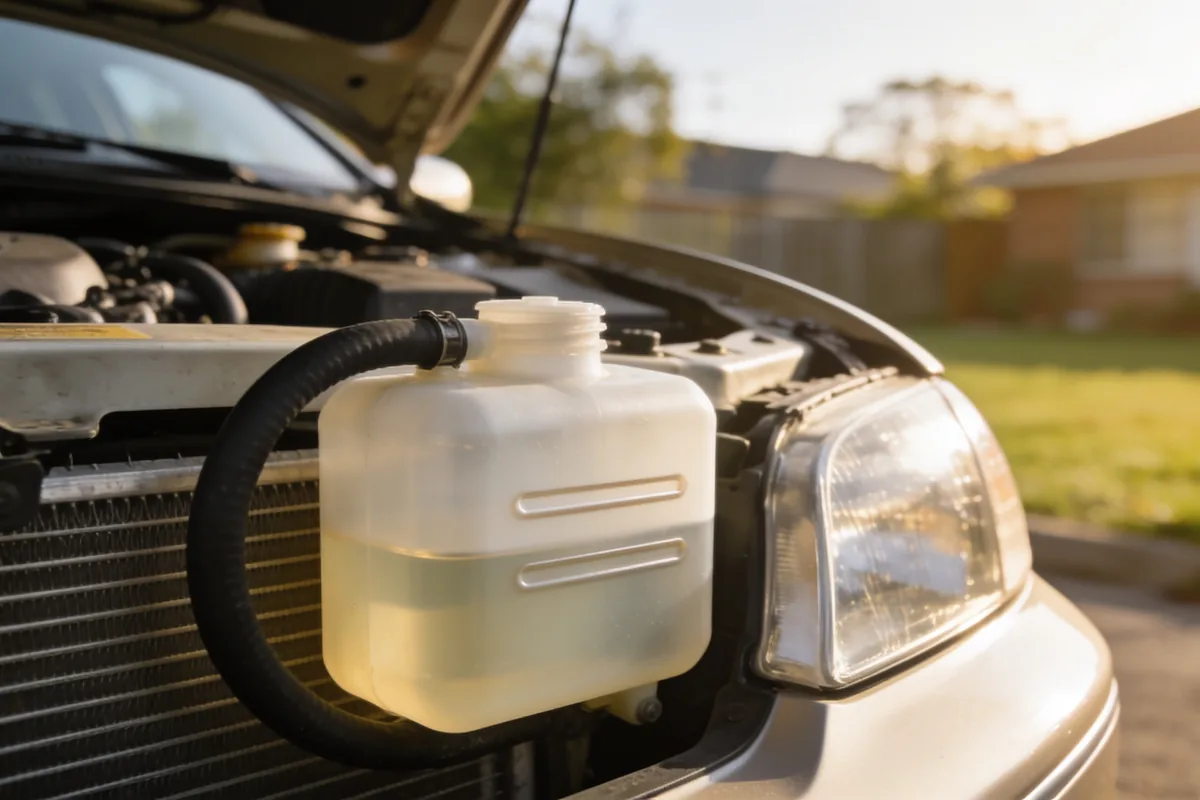
RAA advises checking the coolant only when the engine is cold, because otherwise liquid can spurt out and burn. The check itself is a look at the plastic flow bottle, where the coolant should sit between the low and high lines, about halfway between them. RACQ adds that the owner’s manual explains how to do this for a particular car.
Signs worth a mechanic’s attention
The sources support a short list, and only that:
- a rising temperature gauge or a warning light
- coolant loss
Neither is a diagnosis. Both are reasons to have the car looked at, and RACQ advises having any coolant loss checked immediately.
What the sources settle, and what they leave to the manual
| Question | Settled by the sources | Left to the manual |
|---|---|---|
| Is water a substitute? | No (RACQ) | The coolant the engine is designed for |
| How is the level checked? | Cold engine, between the low and high lines, about halfway (RAA) | Where the reservoir is, and how to read it on this car |
| How often is coolant changed? | Not settled by any source here | The interval, set by the maker (RACV) |
What these figures leave out
The only measurement in this article is the “about halfway” position of the fluid between two marks, attributed to RAA. It excludes the mix ratio of coolant to water, the type of coolant an engine tolerates, the change interval, and whether a particular product suits a particular engine. All four are specific to a vehicle, and none can be read off an article.
It follows that the sources do not rank one coolant over another and neither does this piece. A reader comparing products should compare them against the manual’s specification, and a mechanic or the service booklet can confirm it.
What the manual decides
The owner’s manual decides the type, the mix and the interval, and it explains how to check the level on that car. Water is for getting off the road, a steady gauge is one reading and not a verdict, and the calendar is a guess at a schedule the maker has already written down.
Sources: RACQ, “What to do if your engine overheats” (https://racq.com.au/articles/drive/2023/1/what-to-do-if-youre-engine-overheats); RAA, “Can your vehicle handle the heat?” (https://samove.raa.com.au/can-your-vehicle-handle-the-heat/); RACV, “Easy DIY car maintenance tips and safety checks” (https://www.racv.com.au/royalauto/transport/cars/easy-car-maintenance.html)

NDIS Worker Orientation Module: What to Do While the Online Course Is Offline

Exercise Prescription: How the FITT Principle Builds a Personal Plan

The Spam Act: An Unsubscribe Link Cannot Fix a Message Sent Without Consent
NDIS Worker Orientation Module: What to Do While the Online Course Is Offline

Gutter Overflowing in the Rain? Where to Look First

Engine Coolant Myths: What Water, the Gauge and the Calendar Get Wrong
-
 Healthcare2 days ago
NDIS Worker Orientation Module: What to Do While the Online Course Is Offline
-
 Home & Garden12 months ago
Gutter Overflowing in the Rain? Where to Look First
-
 Automotive12 months ago
Engine Coolant Myths: What Water, the Gauge and the Calendar Get Wrong
-

 Healthcare9 months ago
Stiff Joints in the Morning: What Is Normal and When to See a GP
-
 Home & Garden11 months ago
Galvanised Pipes at Home: Is It Lead You Should Worry About, or Rust?
-
 Healthcare3 days ago
Exercise Prescription: How the FITT Principle Builds a Personal Plan
-

 Home & Garden10 months ago
Cut Your Hot Water Bill: Four Fixes and One to Skip
-

 Family & Parenting12 months ago
Respite Options for Carers of Children with Special Needs