
Automotive
Jump Starting a Car Safely: Where the Standard Method Stops Working

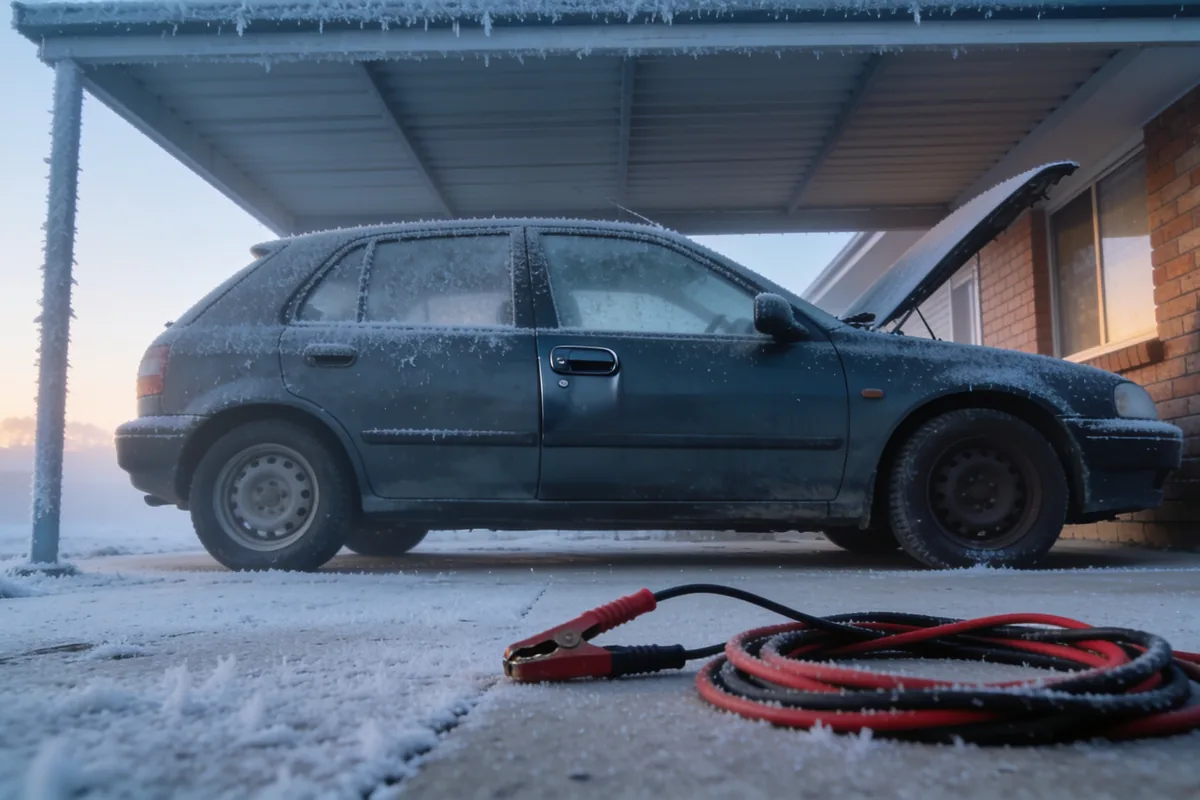
The standard method for jump starting a car is sound for one situation only: a flat battery, a 12-volt system, a second car with a healthy battery, and an owner’s manual that says nothing different. Outside that situation the method stops applying in at least five identifiable ways, and on one step, whether the engine of the donor car should be running, two Australian motoring clubs publish opposite instructions. The finding is therefore short. The handbook for the car in the driveway governs, a roadside service is the fallback when the handbook is unclear, and the generic sequence found on most websites is a floor, not a ceiling.
That finding rests on three documents: a guide from RACV published in March 2026, a jump-start FAQ from RAC in Western Australia, and the jump-starting section of a 2023 Kia owner’s manual for a hybrid model. This article is general information about how to jump start a car, not advice for a particular vehicle. The owner’s manual and a roadside assistance provider are the authorities for any given car, and nothing below replaces them.
Two limits apply. Three documents are a narrow base, and the manual covers one manufacturer’s hybrid, so every row in the table later in this article names its source instead of claiming a rule for all cars. The article also prints only the figures those documents print. It does not rate batteries, price replacements or compare equipment, because none of the three does.
The standard method, and who agrees on it
RACV’s guide, published in March 2026, sets out the sequence most drivers have seen in some form. Written as steps, it reads as follows.
- Switch both cars off, park them or leave them in neutral, and put the handbrakes on.
- Attach one red clamp to the positive terminal of the flat battery.
- Attach the other red clamp to the positive terminal of the charged battery.
- Attach one black clamp to the negative terminal of the charged battery.
- Attach the other black clamp to “a piece of bare, unpainted metal on the car with the flat battery (such as a nut on the engine block)”. RACV adds that this clamp must not go on the flat battery’s terminal.
- Start the charged car and let it run for one minute.
- Start the car with the flat battery, and leave both cars running for several minutes.
- Disconnect the clamps in the reverse order.
- Drive for 10 to 20 minutes.
Most of that sequence is uncontroversial, and the step people argue about most is the fifth: the habit of clamping the last lead to the flat battery’s negative terminal because the colours match. RACV says not to, and the Kia manual agrees, which matters because a motoring club and a vehicle manufacturer have no obvious reason to coordinate their wording.
The manual gives its reason in two parts. A battery produces hydrogen gas, and the manual says that gas “will explode if exposed to flame or sparks”. It then instructs the reader not to connect the booster’s negative directly to the discharged battery’s negative, but to a metallic point “far away from the battery”. Neither document says which individual connection is the likeliest to spark, and this article does not guess. What the two sources establish is the instruction, the hazard it addresses and the agreement between them.
Both documents also steer the reader away from improvising. RACV states a rule: “Always refer to your car’s manual for model-specific instructions”. The Kia manual recommends that, if in doubt, a competent technician or towing service should do the jump start. RACV also notes that an incorrect jump start can cause problems with a car’s electrical systems, which is the stated cost of getting the order wrong.
The sequence quietly assumes four things: that the system is 12 volt, that the flat battery is in a usable physical state, that the donor car can safely act as a donor, and that the battery is flat for an ordinary reason, such as a light left on, and not because it is failing. Each is a place where at least one of the three sources says the method no longer applies, and the sections below take them in turn.
Where two motoring clubs disagree
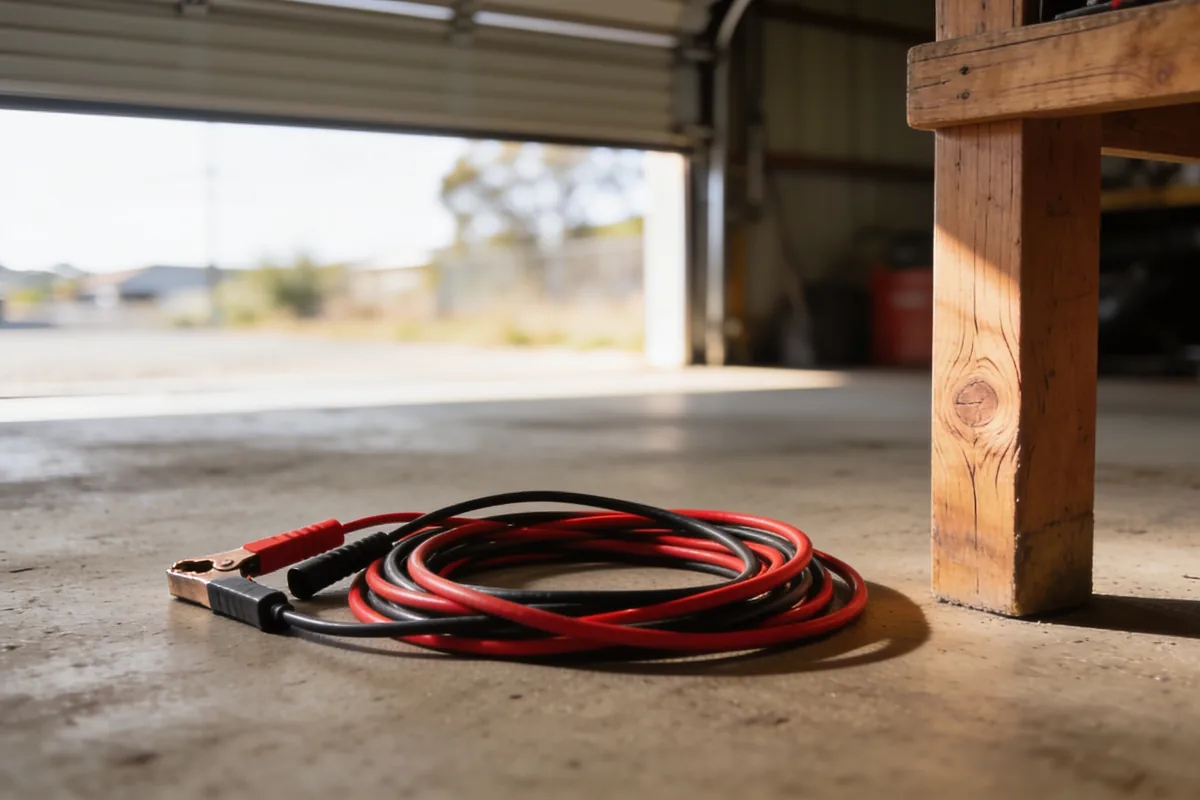
The sixth step is where RACV and RAC part company. RACV tells the reader to start the donor car and let it run for one minute, then to start the flat car and leave both running for several minutes. RAC says the opposite. Its FAQ states that once the leads are correctly connected the reader should not start the car with the good battery, and that “the engine of the vehicle with the good battery should not be running during the procedure”.
RAC gives a reason. Leaving the donor engine off “helps reduce the voltage differential between the two batteries, which reduces the risk of a spike”. The page recommends spike-protected jumper leads, and it concedes that “there is always a risk of electronic damage when performing a jump start”. The two clubs also differ on what follows the jump. RACV says to drive for 10 to 20 minutes. RAC says that after a battery has been depleted it “will need a full recharge using a battery charger”.
| Point | RACV (guide, March 2026) | RAC (FAQ) |
|---|---|---|
| Donor engine during the procedure | Start it, run it for one minute, then keep both cars running for several minutes | Do not start it; it should not be running |
| Stated reason | Not given in the passage read | Lower voltage differential between the batteries, so a lower risk of a spike |
| Leads | No type specified in the passage read | Spike-protected jumper leads recommended |
| After the car starts | Drive for 10 to 20 minutes | A depleted battery needs a full recharge with a battery charger |
| Handbook | “Always refer to your car’s manual for model-specific instructions” | Not stated in the passage read |
The table leaves out any judgement about which club is right, and that is deliberate. Neither club publishes test data in the pages read, the Kia manual does not state the donor-engine step at all, and a ruling built on thin evidence would only add a third opinion to a field that already has two. What can be said is narrower. Where the owner’s manual covers the point, the manual decides it, and RACV says so in terms. Where the manual is silent, the reader holds two published positions from two motoring clubs, and the safer course is to hand the question to a roadside service instead of choosing between them in a cold car park.
Five cases where the standard steps stop working
The table sets out the five situations the sources identify. Each row names its document, and none adds a rule that the document does not state.
| Situation | What the source says | What follows |
|---|---|---|
| A hybrid used as the donor | Kia hybrid manual (2023 edition): “Do not jump start another vehicle with your hybrid vehicle. Jump starting another vehicle will damage the hybrid vehicle’s 12 volt battery.” | Do not use that hybrid as the donor. Use a different vehicle or a roadside service |
| A 24-volt supply | Kia hybrid manual: “Use only a 12-volt jumper system”. A 24-volt supply can damage a 12-volt starting motor, ignition and other parts “beyond repair” | Confirm the supply is 12 volt before any clamp is attached; a supply that cannot be confirmed should not be connected |
| A frozen battery, or one with low electrolyte | Kia hybrid manual: do not jump start if the discharged battery is frozen or the electrolyte is low | Stop, and use a technician or towing service, which the manual recommends in cases of doubt |
| A battery that goes flat again soon | RACV: “it may be time for a new battery. Do not rely on continually jump starting” | Treat the repeat as a sign about the battery, not about the method |
| The donor-engine step | RACV: donor runs for one minute, then both run. RAC: donor engine should not run | Follow the car’s handbook; if it is silent, use a roadside service |
The table leaves out three things. It says nothing about the health of any battery, because none of the sources offers a test. It carries no costs, because none prints a price. And it is not a model-by-model list: the hybrid rule comes from one manufacturer’s manual for one hybrid, and this article does not extend it to other makes, which may word the point differently or not address it at all.
Two rows answer questions that readers ask often. The first is whether a hybrid can be used to jump someone else’s car. The Kia manual says no, and gives the reason: the hybrid’s own 12-volt battery can be damaged. It is easy to assume that a hybrid has power to spare and should make a good donor, but the manual’s wording points the other way. Whether another manufacturer’s manual says the same is a question for that manual.
The second is the 24-volt row, where the manual’s language is strongest. Damage “beyond repair” is its phrase, and it attaches to the starting motor, the ignition and other parts. The instruction to use only a 12-volt system is about the source of the power, whatever sits on the other end of the leads.
Leads or a pack?
A portable jump pack avoids the need for a second car, which is its obvious appeal, and RAC recommends spike-protected leads for anyone who does use a donor. Neither the RACV nor the RAC page compares leads with a pack, and this article names no product and prints no rating, because nothing in the sources supports one. The handbook governs either way, and a pack does not remove the 12-volt requirement or the warning about a frozen battery.
When another jump is the wrong answer
The battery that goes flat again soon is the case in which the method works and the problem remains. RACV’s wording is direct: if the battery dies again soon, “it may be time for a new battery”, and the reader should not rely on continually jump starting. The qualifier “may” is RACV’s, and it is right to keep it. Take a hypothetical driver whose battery goes flat once, after an interior light was left on overnight. That is one event with an obvious cause. If the same battery goes flat again soon afterwards, it is a different event, and the first jump start has done nothing to explain it. The method restarted the car; it did not diagnose anything.
RAC’s point about recharging touches the same case. RAC says a depleted battery needs a full recharge using a battery charger, while RACV says to drive for 10 to 20 minutes. The two clubs do not agree on whether the drive is enough, and this article does not decide it. Both statements treat the jump start as the first part of the job and not the whole of it.
This section gives no guidance on choosing a replacement, no cost and no method for testing a battery, because the sources give none. The Kia manual’s recommendation applies here as it does elsewhere: where there is doubt, a competent technician or towing service is the safer way to get the car moving.
What forums get right and wrong
A common view among drivers online is that connecting red to red and black to black has always worked, and for a healthy, plain 12-volt battery that is true often enough to persuade people. The weakness of the view is that it says nothing about a hybrid donor, a 24-volt supply, a frozen battery or the voltage spike RAC describes, because in the ordinary case none of those arises. A method that has always worked has only ever been tried in the ordinary case.
The same discussions contain a more useful habit: preferring bare metal to the flat battery’s negative terminal. That habit has a stated reason in the Kia manual, hydrogen gas and sparks, and it has the support of RACV. It is the part of the folklore worth keeping.
Check the Handbook First
This article asks for one step, and it takes a few minutes. Find the page in the car’s owner’s manual headed “jump starting”, or its nearest equivalent, and read it before the day it is needed. Note whether it addresses the donor engine, whether it says anything about hybrids or the 12-volt requirement, and whether it names a particular terminal or metal point for the last clamp. If the page is silent on any of those, the roadside service number is the next thing to store in the phone.
Sources: RACV, Car battery guide: how they work, when to replace them, and how to jump-start, 26 March 2026 (https://www.racv.com.au/royalauto/transport/cars/car-battery-guide-how-to-know-if-it-needs-replacing.html); RAC, Car Doctor: jump start (https://rac.com.au/faq/cm_car_doctor_jumpstart); Kia owner’s manual, hybrid (model code MQ4), 2023 edition, Jump-starting (https://ownersmanual.kia.com/full_webhelp/MQ4KH/2023/en_US/topics/t00636.html)
Three common beliefs about engine coolant do not hold up against what the motoring clubs say: that plain water is an acceptable substitute, that a steady temperature gauge shows a healthy system, and that coolant either never needs changing or changes on a fixed calendar. In each case the same authority settles the question. It is the vehicle maker’s owner’s manual, which RACQ, RAA and RACV all point the reader towards, with a mechanic for any remaining doubt.
What the cooling system does
Engine coolant circulates through the engine, the radiator and the hoses, moving heat out of the engine. That description is all the detail the argument below requires. It carries no temperature figures, because a number that is right for one engine is not right for another.
Three myths, set against the evidence
| Claim | What the evidence says | Who says so |
|---|---|---|
| Water is enough | Adding water alone will not fix an overheating problem, and refilling a hot engine with cold water can cause major damage | RACQ |
| If the engine is not overheating, the system is fine | Coolant levels should be checked regularly, and any coolant loss should be checked immediately | RACQ |
| Coolant never needs changing | The type of coolant and how often it is changed are set by the vehicle maker, and the manual or service booklet is the guide | RACV |
The second row separates two different things. A temperature gauge reports the engine’s temperature, and a level check reports how much coolant is in the system. RACQ treats the level as something to watch in its own right, which is why a normal gauge reading does not close the question.
The third row explains why this article gives no change interval. Any figure quoted without a make, model and engine attached would be a guess. The calendar is a convenient proxy for a service schedule. It is not one.
There is a fair point on the other side of the first row. Where a driver is stranded with an empty system, water to get the car off the road is better than driving on with nothing, and that is this article’s own position, not a rule quoted from a club. What matters is the step that follows: have the system checked, because the water has not corrected whatever lost the coolant in the first place.
The three rows read together
Taken together, the rows describe a sequence and not three separate rules. The level is checked on a cold engine, at intervals, against the marks on the reservoir. A level that keeps falling is reported to a mechanic, because coolant loss is the thing RACQ says to have checked immediately. The fluid that goes back in is the one the manual names, and the manual’s schedule says when it is renewed. Water enters this sequence in one place only, as a stopgap to get off the road.
A hypothetical case shows how the rows interact. (Everything in it is invented for illustration.) Take a driver whose temperature gauge has always sat in the middle and who has never opened the bonnet. The gauge reading says nothing about the level, so the level is unknown. If that driver tops up with water after noticing a low bottle, the system is fuller, but the cause of the loss is unaddressed, and the coolant that remains is diluted by an unknown amount. The gauge reading would not have told the driver any of those three things.
How to check the level
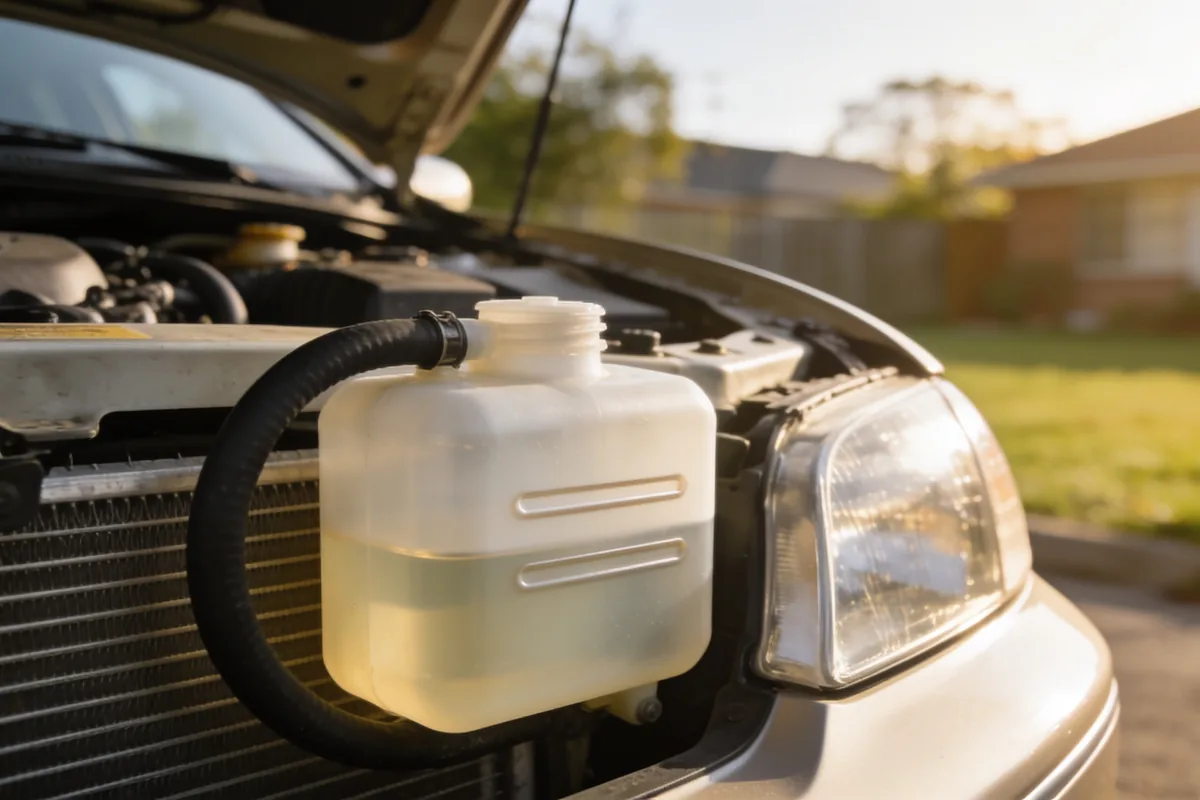
RAA advises checking the coolant only when the engine is cold, because otherwise liquid can spurt out and burn. The check itself is a look at the plastic flow bottle, where the coolant should sit between the low and high lines, about halfway between them. RACQ adds that the owner’s manual explains how to do this for a particular car.
Signs worth a mechanic’s attention
The sources support a short list, and only that:
- a rising temperature gauge or a warning light
- coolant loss
Neither is a diagnosis. Both are reasons to have the car looked at, and RACQ advises having any coolant loss checked immediately.
What the sources settle, and what they leave to the manual
| Question | Settled by the sources | Left to the manual |
|---|---|---|
| Is water a substitute? | No (RACQ) | The coolant the engine is designed for |
| How is the level checked? | Cold engine, between the low and high lines, about halfway (RAA) | Where the reservoir is, and how to read it on this car |
| How often is coolant changed? | Not settled by any source here | The interval, set by the maker (RACV) |
What these figures leave out
The only measurement in this article is the “about halfway” position of the fluid between two marks, attributed to RAA. It excludes the mix ratio of coolant to water, the type of coolant an engine tolerates, the change interval, and whether a particular product suits a particular engine. All four are specific to a vehicle, and none can be read off an article.
It follows that the sources do not rank one coolant over another and neither does this piece. A reader comparing products should compare them against the manual’s specification, and a mechanic or the service booklet can confirm it.
What the manual decides
The owner’s manual decides the type, the mix and the interval, and it explains how to check the level on that car. Water is for getting off the road, a steady gauge is one reading and not a verdict, and the calendar is a guess at a schedule the maker has already written down.
Sources: RACQ, “What to do if your engine overheats” (https://racq.com.au/articles/drive/2023/1/what-to-do-if-youre-engine-overheats); RAA, “Can your vehicle handle the heat?” (https://samove.raa.com.au/can-your-vehicle-handle-the-heat/); RACV, “Easy DIY car maintenance tips and safety checks” (https://www.racv.com.au/royalauto/transport/cars/easy-car-maintenance.html)

NDIS Worker Orientation Module: What to Do While the Online Course Is Offline

Exercise Prescription: How the FITT Principle Builds a Personal Plan

The Spam Act: An Unsubscribe Link Cannot Fix a Message Sent Without Consent
NDIS Worker Orientation Module: What to Do While the Online Course Is Offline

Gutter Overflowing in the Rain? Where to Look First

Engine Coolant Myths: What Water, the Gauge and the Calendar Get Wrong
-
 Healthcare2 days ago
NDIS Worker Orientation Module: What to Do While the Online Course Is Offline
-
 Home & Garden12 months ago
Gutter Overflowing in the Rain? Where to Look First
-
 Automotive12 months ago
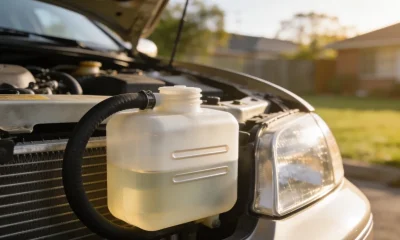
Engine Coolant Myths: What Water, the Gauge and the Calendar Get Wrong
-

 Healthcare9 months ago
Stiff Joints in the Morning: What Is Normal and When to See a GP
-

 Home & Garden11 months ago
Galvanised Pipes at Home: Is It Lead You Should Worry About, or Rust?
-
 Healthcare3 days ago
Exercise Prescription: How the FITT Principle Builds a Personal Plan
-

 Home & Garden10 months ago
Cut Your Hot Water Bill: Four Fixes and One to Skip
-

 Family & Parenting12 months ago
Respite Options for Carers of Children with Special Needs